

2026. The Technical Solution.
You may use the NDEV Space right now and enter NDEV / WDC Analyst porta to learn about a proposed technical solution for a new Legal Tender
If your work is related to ‘Economical models’ of the future, you may verify the Mathematical Appendixes created by OpenAI and conclusions on the page
Document Status:
• Conceptual Technical Archive
• Version: v4.0 (Archive 2025)
• Scope: NDEV / HSBN / WDC
• Purpose: Preservation of architectural logic and formulas
• Not policy, not proposal, not instruction
• Open analytical resource
Prefatory Note (Creative and Engineering Modes)
The texts collected in this section are analytical and technical in nature and are intended for readers with backgrounds in information technology, systems engineering, finance, or economics.
This material is not a proposal, advocacy document, forecast, or prediction. It presents a structured exploration of a possible solution framework addressing observed structural challenges in the global economic system as of the mid-2020s.
This section forms part of the NDEV Code–based World Digital Currency (WDC) research archive, continuing from prior analytical work completed during the 2019–2025 period.
Canonical Archive Version
2026. The Outcome
Structure of the Content- what is being done now.
The material is organised into the following parts:
· Part 0 — Introduction
Conceptual and narrative framing used to contextualise the analytical model.
· Part 1 — NEV Text: Future Economy
Formal definitions and structural reasoning concerning National Equivalents of Value (NEVs).
· Part 2 — NEV World Economy
System-level analysis of how NEVs interact across territories and economic regions.
· Part 3 — NDEV Code and NDEV Token Creation
Technical description of tokenisation, settlement logic, and constraint mechanisms.
Part 0— Introduction
Conceptual and narrative framing used to contextualise the analytical model.
Clarifications on Scope and Intent
The content in this section does not constitute:
· policy advice,
· recommendations to governments or regulators,
· calls to action,
· or statements implying urgency or inevitability.
The material is presented for analytical reference and independent interpretation. It records conclusions, considerations, and structural constructs developed during exploratory analysis and system modelling.
The form and content are preserved for archival purposes, reflecting the state of reasoning and design as developed during the referenced period.
The sections that follow contain conclusions and considerations generated through dialogue with AI, offered for reflection by both human experts and AI systems.
The text reflects the dialogues with AI and is provided specifically for editing and refinement purposes.
This material is provided as an open analytical resource.
It does not propose policy, investment, or political action.
Please differenciate between ENGINEERING and CREATIVE MODES . Note the ideas of fairy tale The Ramsmile leading to the movie to think about pathways of the Planet Earth Development.
This page is to explore technical solutions to create NDEV Code and NDEV Token





Engineering Mode.
Document Status:
• Conceptual Technical Archive
• Version: v4.0 (Archive 2025)
• Scope: NDEV / HSBN / WDC
• Purpose: Preservation of architectural logic and formulas
• Not policy, not proposal, not instruction
• Open analytical resource
Risk-Neutral Settlement Alternative
A Technical Note on NDEV / HSBN / WDC
Reducing Systemic Conflict Risk Through Resource-Anchored Settlement
Status: Conceptual Technical Framework
Scope: International Settlement, Sovereign Risk, Systemic Stability
Timeframe: 2019–2025 Architecture
Audience: Central banks, sovereign funds, institutional asset managers, risk committees, system architects
1. Purpose of This Note
This technical note presents a risk-neutral settlement architecture designed to reduce systemic instability arising from:
reserve-currency concentration,
opaque cross-border clearing,
debt-driven monetary expansion,
and conflict premiums embedded in resource pricing.
The framework does not propose a new political order, currency replacement, or supranational authority.
It introduces a technical settlement layer that operates alongside existing monetary systems, reducing tail-risk and conflict incentives without altering national sovereignty.
2. Problem Statement: Where Systemic Risk Accumulates
Modern global settlement relies on:
fiat-denominated pricing,
correspondent banking chains,
FX liquidity pools,
and debt-based reserve issuance.
This structure produces three compounding risk vectors:
2.1 FX-Driven Contagion
Settlement depends on currencies whose supply, cost, and availability are influenced by domestic policy objectives, exporting volatility across borders.
2.2 Debt-Anchored Value Representation
Sovereign and intergovernmental debt increasingly represents future taxation promises, not current asset backing, amplifying default and inflation tail-risk.
2.3 Conflict Premium in Resource Pricing
When pricing authority and settlement rails are politically concentrated, resource access becomes a strategic variable, introducing a non-linear escalation risk.
3. Architectural Principle: Separate Value From Power
The proposed framework separates:
value representation from
political control of settlement.
This is achieved through a resource-anchored, cryptographically auditable settlement layer, defined by the following components:
NIW (National Items of Wealth): Real, measurable assets (energy, metals, land, IP, etc.)
NEV (National Equivalent of Value): Declared unit of measurement (e.g., 1 kg gold, 1 MWh energy)
Crypto Code: Tokenized NIW representation with geolocation and metadata
CST (Crypto Split Technology): Secure fragmentation and recombination
NDEV (National Digital Equivalent of Value): Transaction-time digital value proxy
HSBN (Highly Scalable Blockchain Network): Dual-ledger settlement infrastructure
WDC (World Digital Currency): Emergent, non-issued settlement numéraire
4. How the Mechanism Works (Simplified)
4.1 Value Formation Chain
NIW → NEV → Crypto Code → CST Fragments → NDEV → Settlement
Fiat currencies remain in domestic use.
NDEV activates only at the moment of settlement.
No permanent replacement of national money occurs.
4.2 Dual-Ledger Structure (HSBN)
Ledger A (Crypto / NIW): Low-frequency, high-integrity asset anchoring
Ledger B (NDEV): High-frequency transactional settlement
This separation ensures scalability without compromising auditability.
5. Quantitative Risk Reduction (Key Metrics)
5.1 Settlement Cost Reduction
Let:
C_{fx} = FX spread + liquidity premium
C_{corr} = correspondent banking cost
C_{san} = sanction / blockage risk premix
Legacy expected cost:
C_{legacy} = C_{fx} + C_{corr} + C_{san}
NDEV-based settlement:
C_{NDEV} \approx C_{network} + C_{validation}
Result: structural reduction of settlement friction.
5.2 Debt Stability Improvement
Traditional debt:
Debt = Future\ Taxation\ Promise
NDEV-linked debt:
Debt = \sum (Tokenized\ NIW\ Fragments)
This converts debt from political obligation into measurable asset exposure, reducing default non-linearity.
5.3 Conflict Probability Reduction
Let:
P(C) = probability of systemic conflict
L(C) = economic loss if conflict occurs
Expected loss:
E(L) = P(C) \times L(C)
NDEV/HSBN reduces:
P(C) by removing pricing-power incentives,
L(C) by isolating settlement channels from FX and reserve disruptions.
6. Why This Is Not a Currency Project
No issuance authority
No reserve privilege
No monetary policy function
No fiscal transfer mechanism
WDC is not issued.
It emerges mathematically as the equilibrium of NDEV-based settlements.
7. Pilot Implementation Logic (Low-Risk Entry)
7.1 Scope
Energy, metals, or strategic commodities
Bilateral or trilateral corridors
Limited volume, parallel to existing rails
7.2 Characteristics
No FX replacement
No treaty change
No CBDC conflict
Full auditability
This allows stress-free validation without systemic exposure.
8. Strategic Outcome
If adopted incrementally, the framework:
lowers conflict premiums in resource pricing,
stabilizes cross-border liquidity,
reduces incentive for currency-zone expansion,
preserves national sovereignty,
and creates a technical deterrent to escalation.
9. Why Timing Matters
Systemic transitions rarely occur by preference; they occur when:
tail-risk dominates expected return,
debt servicing exceeds growth,
and legacy settlement becomes a liability.
This framework exists to provide a non-violent, technical alternative before forced restructuring scenarios emerge.
10. Closing Statement
This architecture does not attempt to redesign geopolitics.
It redesigns how value is represented and settled, removing the structural incentives that historically convert economic stress into conflict.
Transparency replaces coercion.
Parity replaces dominance.
Settlement becomes a technical process, not a strategic weapon.
End of Technical Note
ENGINEERING MODE
Part 1 — NEV Text: Future Economy
Formal definitions and structural reasoning concerning National Equivalents of Value (NEVs).
National Equivalents of Value (NEVs)
Conceptual Definition and Technical Grounding
1. Definition of National Equivalent of Value (NEV)
A National Equivalent of Value (NEV) is a formally declared, measurable, and verifiable unit of national value used as a reference anchor for economic transactions, digital representation, and tokenised settlement within a distributed financial system.
An NEV is not money, not fiat currency, and not a speculative asset. It functions as a value anchor—a reference unit against which transactions are measured and settled.
An NEV exists independently of:
· monetary policy,
· exchange-rate regimes,
· political cycles,
· credit expansion mechanisms.
Its primary function is value anchoring rather than circulation.
2. Gold as the Initial NEV (Gold-NEV)
Gold is designated as the initial and baseline NEV based on the following properties:
· universal recognition of value,
· physical scarcity,
· long-term stability,
· established global valuation mechanisms,
· scientific measurability,
· historical neutrality across economic systems.
Formal Definition (Gold-NEV)
Gold-NEV is defined as 1 kilogram of gold of specified purity and quality, declared by a national authority.
During initial system formation, all other NEVs are derived from or anchored to Gold-NEV. This ensures:
· immediate cross-jurisdictional comparability,
· minimal interpretive ambiguity,
· deterministic conversion logic for technical systems.
3. Measurement and Precision
Contemporary measurement standards allow Gold-NEV to be defined with non-physical precision, enabling digital consistency:
· weight expressed in SI units,
· quality specified by internationally recognised standards,
· measurement traceable to atomic time and metrological definitions.
This enables subdivision of NEV units without loss of integrity, supporting both micro-transactions and macro-settlements.
4. Relationship Between NEV, NIW, and NDEV (Logical Chain)
The system operates on a strict value-derivation chain:
NIW → NEV → Crypto → NDEV
Where:
· NIW (National Item of Wealth): a real, existing asset such as gold, oil fields, gas reserves, energy infrastructure, technology clusters, or other registered national resources.
· NEV (National Equivalent of Value): the declared reference unit used to measure NIW value.
· Crypto (Tokenised NIW): a digital representation of NIW carrying registration, geolocation, and value parameters.
· NDEV (National Digital Equivalent of Value): a transaction-ready fragment of Crypto, balanced to a defined proportion of NEV.
This chain enforces value conservation across physical and digital domains.
5. Anchoring Transactions in HSBN
The High Scalable Blockchain Network (HSBN) does not anchor value to:
· promises,
· credit issuance,
· future expectations.
Value is anchored to declared NEVs derived from existing NIWs.
HSBN Anchor Principle
Every transactional unit recorded in HSBN resolves, directly or indirectly, to a proportion of a declared NEV.
This principle prevents:
· uncontrolled value creation,
· hidden leverage,
· opaque monetary expansion,
· detachment of digital finance from physical reality.
6. Extension Beyond Gold: Derived NEVs
After establishment of Gold-NEV as the base anchor, additional NEVs may be introduced if strict conditions are met.
Eligible NIWs for Derived NEVs include:
· energy reserves (oil, gas),
· electrical generation capacity,
· strategic technologies,
· industrial infrastructure,
· registered territorial resources,
· specific classes of intellectual property.
Each derived NEV must:
· be measurable,
· be geographically registered,
· be auditable,
· be pegged to Gold-NEV for cross-system parity.
7. Relevance of Energy, Resources, and Technology
These assets:
· represent real economic work capacity,
· underpin industrial and societal functioning,
· retain long-term strategic value.
Tokenisation without NEV anchoring introduces speculative dynamics.
Tokenisation with NEV anchoring enables deterministic settlement.
Within HSBN:
· Oil-NEV, Gas-NEV, Energy-NEV, or Technology-NEV do not replace Gold-NEV,
· stability is inherited through anchoring to Gold-NEV.
8. Transaction Grounding Logic
Each HSBN transaction satisfies the following sequence:
1. identification of the NIW,
2. mapping to a declared NEV,
3. conversion to Crypto,
4. fragmentation into NDEV units,
5. settlement without reliance on fiat value anchoring.
Fiat currencies may appear at interface layers only and do not function as value anchors.
9. System Outcome
Under this framework, the system exhibits:
· deterministic valuation,
· transparent settlement,
· cross-border neutrality,
· resistance to monetary distortion,
· compatibility with automated analytical and computational systems.
NEV provides the reference ground.
NDEV enables transactional motion.
HSBN functions as the settlement medium.
NEV-Based Future Economy Architecture — System Behaviour at Scale
This section describes an analytical framework for modelling a future economic architecture based on National Equivalents of Value (NEVs) and an NDEV Code–based World Digital Currency (WDC) at system scale.
The framework addresses the following analytical domains:
· conceptual architecture of NEVs as reference value units,
· formal classification of resources eligible for value representation (including energy, minerals, land, production capacity, renewable assets, and related categories),
· mathematical relationships linking:
· geography to registered resources,
· resources to value units,
· value units to divisible digital settlement instruments,
· normalisation mechanisms through which heterogeneous resources are rendered comparable,
· geolocation constraints that bind value representation to territorial origin rather than abstract tradability,
· stability and incentive properties of the resulting system.
The framework is explicitly limited to analytical and design-level modelling. It does not incorporate live, proprietary, or authoritative datasets and does not certify real-time resource quantities or national declarations. Authoritative resource data, reserve verification, and legal certification are external inputs originating from states, institutions, or publicly available sources.
The analytical model operates using:
· abstract representations of publicly known dataset structures,
· historical and open-reference knowledge concerning resource classes and estimation methodologies,
· synthetic or hypothetical datasets for modelling, validation, and stress testing.
Within this scope, the framework defines:
· data-ingestion requirements specifying the inputs required for NEV calculation,
· validation constraints governing admissible registrations,
· update and decay logic describing how NEV-linked values evolve over time.
The resulting analytical output consists of:
· a formal schema for geospatial resource–value representation,
· equations and constraints governing NEV calculation,
· tokenisation logic compatible with the NDEV Code framework,
· simulation-ready structures mapping defined inputs to deterministic outputs.
At scale, the analytical complexity arises from:
· multi-dimensional modelling across space, time, resources, and value,
· cross-domain reasoning integrating geography, economics, and systems theory,
· enforcement of internal consistency across multiple interacting constraints.
The framework explicitly excludes real-time numerical simulation, live dataset ingestion, and operational optimisation. It is constrained to analytical design, modelling, and verification.
For coherence, the framework assumes the following fixed conditions:
1. a clear definition of NEV as a value reference unit,
2. explicit classification of eligible resource types,
3. geolocation binding at the point of value issuance,
4. non-hegemonic issuance constraints,
5. exclusive use of public or synthetic data,
6. absence of political or operational claims.
Under these conditions, the framework supports:
· formal NEV schemas,
· geographical resource–value mapping logic,
· NDEV-compatible tokenisation rules,
· comparative regional analysis,
· analytical stability and incentive evaluation.
This work defines a technically coherent draft architecture for analysing a future large-scale economic system. It is intended for examination, critique, and long-term conceptual development rather than deployment or prescription.
NEV Definition v1.0 (Gold-First, HSBN-Ready)
0) Purpose
A National Equivalent of Value (NEV) is a declared, audit-anchored, geolocated value basis for issuance and settlement of a non-hegemonic settlement unit within HSBN using the NDEV Code.
An NEV is not a price. It functions as a verifiable value anchor that constrains issuance and settlement so that value does not exist as a purely abstract quantity.
1) Core Definition
1.1 NEV (Formal)
For a territory T (national jurisdiction or declared settlement zone), define:
NEVT=the declared ledger of value anchors for T,\text{NEV}_T = \text{the declared ledger of value anchors for } T,NEVT=the declared ledger of value anchors for T,
expressed as a set of anchor classes AiA_iAi (initially Gold), where each anchor entry is:
Ai(T)=⟨AssetClass, Quantity, QualitySpec, GeoFence, CustodyProof, AuditProof, UpdateRule, EncumbranceState⟩A_i(T) = \langle \text{AssetClass},\ \text{Quantity},\ \text{QualitySpec},\ \text{GeoFence},\ \text{CustodyProof},\ \text{AuditProof},\ \text{UpdateRule},\ \text{EncumbranceState} \rangleAi(T)=⟨AssetClass, Quantity, QualitySpec, GeoFence, CustodyProof, AuditProof, UpdateRule, EncumbranceState⟩
NEV is the sum of eligible anchors after applying eligibility and haircut rules:
NEVT=∑i∈Eligible(T)Haircuti⋅f(Ai(T))\text{NEV}_T = \sum_{i \in \text{Eligible}(T)} \text{Haircut}_i \cdot f(A_i(T))NEVT=i∈Eligible(T)∑Haircuti⋅f(Ai(T))
where f(⋅)f(\cdot)f(⋅) converts a measured anchor into a standardised value unit for issuance constraints.
2) Gold as NEV Anchor (Stage 1 — Mandatory Base)
2.1 Gold Anchor Class (AU-NEV)
AU-NEV is the initial anchor class and calibration reference. Each AU entry includes:
· Quantity: fine troy ounces or grams
· QualitySpec: purity threshold (e.g., ≥ 0.995) and bar standard (LBMA/Good Delivery or declared equivalent)
· GeoFence: custody location coordinates and jurisdiction boundary
· CustodyProof: cryptographic proof of controlled custody (custodian signature and facility identifier)
· AuditProof: independent audit attestation (hash, timestamp, issuer identity)
· EncumbranceState: unencumbered / pledged / leased / disputed
· UpdateRule: periodic audit cycle and event-driven updates (movement, pledge, seizure, loss)
Eligibility rule (Gold):
Only audited, unencumbered, geofenced custody is eligible for issuance backing.
2.2 Engineering Rationale
Gold provides:
· high value density,
· global recognisability,
· comparatively stable long-term characteristics,
· standardised quality and custody frameworks.
Gold functions as a bootstrapping anchor for calibration rather than as the entirety of the system.
3) Extending NEV Beyond Gold (Stage 2 — Resource Anchors)
After stabilisation of AU-NEV, NEV may extend to additional anchor classes to bind settlement to real constraints.
3.1 Energy Anchors (Priority)
Examples include Oil (OIL-NEV), Gas (GAS-NEV), and Electricity Base Capacity (ELEC-NEV).
Each energy anchor includes:
· Quantity: proved recoverable reserves or guaranteed generation capacity
· QualitySpec: grade, deliverability, grid specifications
· GeoFence: field, pipeline, or grid node coordinates
· Extraction/DeliveryProof: metering, transport capacity, dispatch verification
· AuditProof: third-party reserve or metering audits
· EncumbranceState: licences, liens, production-sharing obligations, export restrictions
Eligibility rule (Energy):
Only the deliverable portion within declared infrastructure constraints is eligible. Conservative haircuts apply for technical and geopolitical constraints.
3.2 Strategic Materials Anchors (Optional)
Examples include copper, nickel, lithium, uranium, and rare earths. The same structural requirements apply: quantity, grade, geofence, custody or production proof, audit, and encumbrance status.
3.3 Technology and Productive Capacity Anchors (Deferred)
Technology and productivity anchors require distinct logic due to standardisation and manipulation risks. These anchors are treated as secondary and risk-weighted until measurement standards are established.
4) HSBN Anchor Mechanism
4.1 Anchor-to-Token Mapping
HSBN issues Anchor Tokens (ATokens) representing eligible anchors with embedded constraints:
AToken=⟨AnchorID, ValueUnits, GeoFence, SplitRules, TransferRules, AuditHash, Expiry/Refresh⟩\text{AToken} = \langle \text{AnchorID},\ \text{ValueUnits},\ \text{GeoFence},\ \text{SplitRules},\ \text{TransferRules},\ \text{AuditHash},\ \text{Expiry/Refresh} \rangleAToken=⟨AnchorID, ValueUnits, GeoFence, SplitRules, TransferRules, AuditHash, Expiry/Refresh⟩
4.2 Geolocation Constraint
Each anchor carries a GeoFence specifying location and jurisdiction. This prevents:
· abstract relocation of backing,
· issuance detached from territory,
· arbitrage via jurisdiction switching.
4.3 Divisibility and Settlement
ATokens are divisible into transactional units while preserving:
· traceability to AnchorID,
· proportional claim logic,
· geofence constraints,
· audit continuity.
5) Issuance Constraint
5.1 Issuance Ceiling
Total circulating settlement units for territory T are bounded by eligible NEV:
SupplyT≤α⋅NEVT\text{Supply}_T \le \alpha \cdot \text{NEV}_TSupplyT≤α⋅NEVT
where α\alphaα is a conservative policy coefficient at system initiation and NEV excludes encumbered or unaudited anchors.
5.2 Haircuts
Each anchor class applies a haircut based on:
· audit reliability,
· custody integrity,
· deliverability,
· volatility,
· legal encumbrance,
· infrastructure constraints.
Gold haircuts may be minimal under strong custody; energy anchors typically carry higher haircuts.
6) Debt Re-Anchoring Mechanism
Debt obligations are re-anchored rather than eliminated.
6.1 Revaluation Principle
Legacy debt instruments are measured against NEV-constrained settlement units rather than unlimited abstract issuance. This:
· limits unbounded monetary expansion,
· aligns obligations with audited anchors over time,
· increases transparency of real constraints.
7) Minimal Data Standard
7.1 Required Registries
1. NEV Registry: anchor entries and status per territory
2. Custody Registry (Gold): custodians, facilities, movements
3. Production/Delivery Registry (Energy): metering and transport capacity
4. Audit Registry: attestations, signatures, hashes, schedules
5. Encumbrance Registry: liens, pledges, disputes, legal flags
7.2 Cryptographic Primitives
· digital signatures (custodian, auditor, issuer),
· hashing of audit statements and snapshots,
· timestamping (public or consortium),
· immutable append-only logging within HSBN.
8) Conceptual Flow (Descriptive)
Territory T
→ declaration, audit, geofencing
→ NEV Registry (Gold-first)
→ eligible anchors only
→ Anchor Tokens
→ issuance constrained by SupplyT≤α⋅NEVT\text{Supply}_T \le \alpha \cdot \text{NEV}_TSupplyT≤α⋅NEVT
→ WDC settlement within HSBN
→ transactions carrying anchor linkage and geofence constraints.
9) NEV v1.0 Scope Completion
NEV v1.0 (Gold-first) is defined when:
· the AU-NEV schema is fixed,
· eligibility and haircut rules for gold are specified,
· registry fields are defined,
· the issuance ceiling rule is stated,
· audit and custody workflows are specified.
NEV v1.1 — Gold Registry Specification
Fields, Proofs, Audit Workflow, Example Records
(Metric Units; Gold as One Anchor Class Only)
NEV is defined as an explicit, audited, geolocated value-anchor registry. Within this framework, the NDEV Code constrains issuance and settlement to eligible anchors, making value representation non-abstract and mathematically testable under declared assumptions.
All quantities in this specification use metric units: grams (g), kilograms (kg), and tonnes (t). Where other units exist in historical or external standards, values are normalised and stored in grams as the base unit.
Scope Note
Gold is specified here as AU-NEV (one Anchor Class) inside the broader NEV framework. Additional anchor classes (e.g., energy, minerals) may be introduced later using the same registry pattern, proof requirements, and eligibility rules.
1) Registry Purpose and Position in HSBN / NDEV
The Gold Registry defines the data structure by which gold holdings become eligible as a value anchor for issuance constraints and settlement within HSBN.
It provides:
· a geolocated and audited representation of gold holdings,
· a cryptographically verifiable chain of custody and audits,
· an encumbrance-aware eligibility filter,
· a basis for calculating eligible gold for NEV and enforcing the issuance constraint:
SupplyT≤α⋅NEVTSupply_T \le \alpha \cdot NEV_TSupplyT≤α⋅NEVT
2) Entities and Roles (Minimum)
· Territory Issuer (TI): declares AU-NEV entries for territory TTT and publishes signed snapshots.
· Custodian (C): physically holds gold and signs custody proofs.
· Auditor (A): verifies custody, quantity, and quality and signs audit attestations.
· HSBN Registry Node(s): store immutable registry events and snapshots (append-only).
· Verifier(s): validate signatures, hashes, and eligibility rules.
3) Data Model Overview
The registry uses an event-sourced model (append-only events) plus periodic snapshots.
3.1 Core Objects
· GoldAnchor (asset record)
· CustodyEvent (movement or change of custody)
· AuditAttestation (audit result)
· EncumbranceRecord (pledge/lien/lease/dispute flags)
· Snapshot (signed state of all eligible anchors at time ttt)
4) GoldAnchor Record — Required Fields (AU-NEV)
4.1 GoldAnchor (AU-NEV) — Conceptual Schema
GoldAnchor
· anchor_id (string; immutable, globally unique)
· territory_id (string; ISO + internal zone code)
· asset_class = "AU"
· quantity_mass_g (number; grams as base unit)
· accepted input units: g / kg / t; stored as grams
· purity_ppm (integer; e.g., 995000 for 0.995)
· form_factor (enum): bar | coin | granules | other
· standard_ref (string; optional reference)
· serials (array of strings; bar IDs / container IDs if available)
· custody (object):
· custodian_id (string)
· facility_id (string)
· geo_fence (object; mandatory):
· lat (float)
· lon (float)
· radius_m (integer) or polygon coordinates
· jurisdiction_code (string)
· custody_start_utc (datetime)
· legal_status (object):
· ownership_type (enum): sovereign | institutional | trust | mixed
· encumbrance_state (enum): unencumbered | pledged | leased | disputed | unknown
· encumbrance_ref_ids (array of strings)
· audit_state (object):
· last_audit_utc (datetime)
· audit_frequency_days (integer)
· auditor_id (string)
· audit_attestation_id (string)
· confidence_score (0–100) (optional)
· eligibility_state (enum): eligible | ineligible | suspended
· eligibility_reasons (array of codes)
· created_utc (datetime)
· updated_utc (datetime)
· hash_prev (string)
· hash_current (string)
· signatures (object):
· issuer_sig (string)
· custodian_sig (string)
· auditor_sig (string; on attestation)
4.2 Eligibility Rules (Gold, v1.1)
A GoldAnchor is eligible only if all conditions hold:
1. encumbrance_state == unencumbered
2. last_audit_utc is within the audit_frequency_days window
3. valid geo_fence present
4. quantity_mass_g > 0 and purity_ppm >= threshold_ppm (territory-defined)
5. Custodian and Auditor signatures verify
6. no open dispute flag
5) Proof Requirements (Cryptographic and Procedural)
5.1 Custody Proof (C-Proof)
Minimum evidence includes a custodian-signed statement referencing:
· anchor_id
· facility identifier and geofence
· measured mass (grams)
· seal/container/serial references
· timestamp
Outputs:
· custody_proof_hash
· custodian_sig(custody_proof_hash)
5.2 Audit Attestation (A-Proof)
Audit attestation includes:
· inspection method (counting/weighing; sampling rules)
· mass reconciliation (declared vs observed)
· purity verification method
· custody reconciliation (facility match and seal check)
· encumbrance verification
Outputs:
· audit_attestation_hash
· auditor_sig(audit_attestation_hash)
5.3 Snapshot Proof (S-Proof)
Periodic signed snapshot of:
· all GoldAnchors,
· eligibility states,
· total eligible gold in grams (with optional kg/t derivations for readability)
Outputs:
· snapshot_hash
· issuer_sig(snapshot_hash)
· optional multi-signature from auditor/custodian consortium
6) Audit Workflow (Operational Sequence)
6.1 Onboarding (Initial Registration)
1. TI creates anchor_id
2. Custodian produces C-Proof
3. Auditor performs initial audit and produces A-Proof
4. Registry node records:
· GoldAnchorCreated
· CustodyConfirmed
· AuditAttached
1. Eligibility may be set to eligible only after proof validation
6.2 Routine Operation (Maintenance)
· Each audit cycle:
1. Auditor re-checks quantity, purity, custody, and encumbrance
2. Posts updated AuditAttestation
3. Registry updates audit_state
4. Eligibility is recalculated
· Any custody movement triggers:
· CustodyTransferEvent with updated geofence
· shortened audit requirement window
6.3 Exception Handling
· If pledge/lease/dispute detected:
· add EncumbranceRecord
· set eligibility_state = ineligible (or suspended)
· If audit overdue:
· set eligibility_state = suspended until renewed
· If mismatch found:
· record IncidentEvent
· freeze issuance against that anchor until resolution
7) Example Records (Simplified, Metric)
7.1 Example GoldAnchor (Eligible)
anchor_id: "AU-T-AUS-000001"
territory_id: "AUS-T1"
asset_class: "AU"
quantity_mass_g: 125000000 // 125,000 kg = 125 t
purity_ppm: 999000
form_factor: "bar"
serials: ["BAR-0001","BAR-0002","..."]
custody:
· custodian_id: "CUST-AUS-01"
· facility_id: "FAC-SYD-VAULT-01"
· geo_fence: {lat:-33.86, lon:151.21, radius_m:50, jurisdiction_code:"AUS-NSW"}
· custody_start_utc: "2026-01-01T00:00:00Z"
legal_status:
· ownership_type: "sovereign"
· encumbrance_state: "unencumbered"
· encumbrance_ref_ids: []
audit_state:
· last_audit_utc: "2026-01-02T00:00:00Z"
· audit_frequency_days: 90
· auditor_id: "AUD-INT-01"
· audit_attestation_id: "AUDATT-20260102-0001"
eligibility_state: "eligible"
eligibility_reasons: []
hash_prev: "…"
hash_current: "…"
signatures:
· issuer_sig: "SIG(TI)"
· custodian_sig: "SIG(C)"
7.2 Example GoldAnchor (Ineligible: Pledged)
anchor_id: "AU-T-RUS-000014"
territory_id: "RUS-T3"
quantity_mass_g: 50000000 // 50,000 kg = 50 t
purity_ppm: 995000
legal_status:
· encumbrance_state: "pledged"
· encumbrance_ref_ids: ["ENC-LOAN-7782"]
eligibility_state: "ineligible"
eligibility_reasons: ["ENCUMBERED_ASSET"]
7.3 Example Snapshot (Issuer Signed)
snapshot_id: "SNAP-AUS-T1-2026-01-05"
territory_id: "AUS-T1"
timestamp_utc: "2026-01-05T00:00:00Z"
total_gold_g_declared: 130000000
total_gold_g_eligible: 125000000
eligible_anchor_ids: ["AU-T-AUS-000001", "AU-T-AUS-000007"]
snapshot_hash: "HASH(...)"
issuer_sig: "SIG(TI, snapshot_hash)"
8) Outputs for NDEV Code Enforcement (Gold-Only at This Stage)
From the registry, the NDEV Code consumes:
· NEV_T_AU_eligible_g (eligible grams)
· NEV_T_AU_haircut (gold haircut coefficient)
· NEV_T_AU_value_units (conversion to issuance constraint units per concept)
· snapshot_hash and signatures
This yields a constrained issuance ceiling for territory TTT:
SupplyTmax=α⋅(HaircutAU⋅NEVT,AU)Supply_T^{max} = \alpha \cdot (\text{Haircut}_{AU} \cdot NEV_{T,AU})SupplyTmax=α⋅(HaircutAU⋅NEVT,AU)
9) Note on Gold as One NEV Anchor Class
This specification defines AU-NEV as the initial anchor class. The registry pattern is designed to support later anchor classes (Oil, Gas, Energy Capacity, strategic materials, and others) as separate registries with:
· distinct quantity measures,
· deliverability proofs,
· and haircut logic,
while preserving the same HSBN/NDEV integrity rules (geofence, auditability, encumbrance status, and signed snapshots).
NEV v1.2 — Issuance and Settlement Constraint Specification
(Gold-First, Map-Anchored)
This specification defines the issuance and settlement constraints through which National Equivalents of Value (NEVs) become operational within HSBN using the NDEV Code.
Gold (AU-NEV) is specified as the initial anchor class. Additional NEV anchor classes may be introduced later without altering the constraint framework defined here.
A) System Characteristics
Changes Relative to Legacy Monetary Systems
· Value is declared, audited, and geolocated prior to issuance.
· Issuance is constrained by eligible anchors rather than discretionary expansion.
· Settlement units retain anchor lineage rather than existing as abstract balances.
Invariants Preserved
· Territorial sovereignty remains unchanged.
· Market mechanisms continue to price risk.
· Technology enforces declared constraints without determining policy.
B) Geographic Anchoring of NEV
Each territory declares its NEV anchor zones as geographically bounded entities.
For NEV v1.2, only AU-NEV (Gold) is specified.
Each declared zone corresponds to one or more GoldAnchor GeoFences recorded in the NEV registry.
These geographic bindings define where declared value physically resides and constrain eligibility accordingly.
C) Inputs Required by NDEV Code
From the NEV v1.1 Gold Registry, the NDEV Code consumes only eligible, signed, and current data:
1. NEV_T_AU_eligible_g — eligible gold mass (grams)
2. Haircut_AU_T — territory-specific risk haircut
3. Snapshot_hash — signed registry snapshot reference
4. GeoFence_set — list of anchor geofences
5. Audit_window — validity interval for audit status
No prices, forecasts, or discretionary parameters are ingested.
D) Issuance Constraint
For each territory TTT, the issuance ceiling is defined as:
MaxSupplyT=αT⋅(HaircutAU,T×NEVT,AUeligible)\text{MaxSupply}_T = \alpha_T \cdot \left(\text{Haircut}_{AU,T} \times \text{NEV}_{T,AU}^{eligible}\right)MaxSupplyT=αT⋅(HaircutAU,T×NEVT,AUeligible)
Where:
· αT\alpha_TαT is a conservative policy coefficient (typically <1< 1<1 at system initiation),
· haircuts reflect custody integrity, audit quality, deliverability, and legal constraints.
Issuance automatically suspends if anchors become ineligible due to audit expiry, encumbrance, or geofence violation.
E) Settlement Object Structure
Each settlement recorded in HSBN carries minimal, verifiable anchor lineage metadata:
SettlementEnvelope
· amount
· territory_id
· anchor_class = AU
· snapshot_hash
· anchor_proportion_ref (fractional claim reference)
· geofence_constraint_ref
· expiry_or_refresh_ref
Settlement transfers represent claims against anchors rather than movement of the anchors themselves.
F) Geolocation Constraint Enforcement
· Anchors remain valid only within their declared GeoFences.
· Settlement transfers claims, not physical anchors.
· Relocation of custody requires:
· updated geofence declaration,
· new audit attestation,
· suspension of prior claims until validation completes.
This mechanism prevents abstract relocation of backing and hidden rehypothecation.
G) Debt Handling Mechanism
Legacy obligations are settled or rolled exclusively against NEV-constrained issuance.
Consequences include:
· bounded growth of aggregate obligations,
· reduced reliance on crisis-driven resets,
· rebalancing through time and production rather than shocks.
H) Extension to Additional NEV Anchor Classes
The constraint framework supports extension to additional anchor classes (e.g., energy, gas, oil) using the same interface:
· quantity declaration,
· geofence binding,
· audit attestation,
· haircut application,
· signed snapshot publication.
The visual and conceptual frame remains constant while anchor layers expand.
I) Implementation Requirements (Minimum)
· append-only NEV registries compliant with Gold v1.1,
· cryptographic signatures (issuer, custodian, auditor),
· snapshot scheduling and validation,
· NDEV Code constraint enforcement module,
· HSBN settlement envelope validation,
· read-only public map service.
J) Summary Statement
NEV introduces a declared, audited, and geolocated value anchor.
The NDEV Code constrains issuance and settlement to eligible anchors—initially Gold—so monetary value does not exist as pure abstraction.
Geography, custody, and audit status become intrinsic to settlement, defining a system architecture that limits systemic debt expansion and reduces large-scale conflict incentives without removing sovereignty or market mechanisms.
NEV v1.3 — Energy Anchors Specification
Oil, Gas, Electricity
Deliverability-First • Geolocated • HSBN / NDEV-Compatible
This specification defines Energy-Based National Equivalents of Value (NEVs) as anchor classes extending the NEV framework beyond Gold. Energy anchors bind settlement capacity to deliverable energy, constrained by geography, infrastructure, and operational conditions.
Gold (AU-NEV) remains the initial calibration anchor. Energy NEVs provide load-bearing capacity for economic settlement within the same constraint framework.
A) Energy as NEV Anchor Classes
Energy anchors represent deliverable energy, not abstract reserves. Eligibility is limited to quantities that can be physically delivered within declared infrastructure, licensing, and operational constraints.
Defined energy anchor classes:
· OIL-NEV — liquid fuels
· GAS-NEV — pipeline and LNG gas
· ELEC-NEV — firm electrical capacity
Each anchor class follows the same registry and constraint pattern as AU-NEV (v1.1):
quantity declaration → geofence binding → audit attestation → encumbrance evaluation → snapshot publication → haircut application.
B) Geographic Anchoring
Each Energy NEV anchor is bound to one or more GeoFences corresponding to physical assets and infrastructure, including fields, wells, pipelines, terminals, power plants, substations, and grid nodes.
Geographic binding is a constraint mechanism rather than a representational feature and determines eligibility and settlement scope.
C) Quantity Definitions (Metric, Deliverability-Based)
C.1 OIL-NEV
· Quantity: tonnes of deliverable crude per defined period (e.g., t/year)
· Eligibility basis: proved-developed producing capacity within existing infrastructure
· Exclusions: undeveloped reserves, blocked or non-exportable volumes
C.2 GAS-NEV
· Quantity: cubic meters (m³) deliverable per defined period
· Eligibility basis: contracted pipeline or LNG capacity combined with field deliverability
· Exclusions: stranded gas without transport or liquefaction access
C.3 ELEC-NEV
· Quantity: firm megawatts (MW) and corresponding megawatt-hours (MWh/year) at defined nodes
· Eligibility basis: dispatchable or contractually firm capacity
· Exclusions: intermittent output beyond firm guarantees
D) Registry Fields (Energy-Specific Extensions)
Energy anchors extend the base NEV registry schema with the following fields:
· quantity_per_period (t/y, m³/y, MWh/y)
· infrastructure_nodes (pipelines, terminals, substations, grid nodes)
· deliverability_factor (0–1, computed)
· license_window (validity dates)
· maintenance_outages (declared schedules)
· export_constraints (tariff, permit, or regulatory flags)
Eligibility is determined as:
Eligible Quantity=Audited Quantity×Deliverability Factor×Encumbrance Validity×GeoFence Validity\text{Eligible Quantity} = \text{Audited Quantity} \times \text{Deliverability Factor} \times \text{Encumbrance Validity} \times \text{GeoFence Validity}Eligible Quantity=Audited Quantity×Deliverability Factor×Encumbrance Validity×GeoFence Validity
E) Proofs and Audits
Energy anchor eligibility requires verification of:
· Production Proof: metering logs or SCADA-derived records (hashed)
· Infrastructure Proof: nameplate capacity, flow limits, outage records
· Contract Proof: transport or dispatch rights (hashed references)
· Audit Attestation: reconciliation of production, infrastructure, contracts, and site conditions
Snapshots represent forward-looking eligibility for the next audit window rather than static stock declarations.
F) Haircuts
Haircuts reflect operational and physical constraints rather than discretionary or political considerations.
Indicative characteristics:
· Oil: logistics, storage, and marketability → moderate haircuts
· Gas: dependency on pipelines or LNG facilities → higher haircuts
· Electricity: grid congestion and intermittency → variable haircuts
Haircuts are transparent, versioned, and recalculated based on declared inputs.
G) Issuance Constraint (Extended Anchor Set)
The issuance ceiling for territory TTT becomes:
MaxSupplyT=αT⋅∑A∈{AU,OIL,GAS,ELEC}(HaircutA,T×NEVT,Aeligible)\text{MaxSupply}_T = \alpha_T \cdot \sum_{A \in \{AU, OIL, GAS, ELEC\}} \left(\text{Haircut}_{A,T} \times \text{NEV}_{T,A}^{eligible}\right)MaxSupplyT=αT⋅A∈{AU,OIL,GAS,ELEC}∑(HaircutA,T×NEVT,Aeligible)
Automatic effects include:
· outages reducing eligibility and tightening issuance,
· infrastructure expansion increasing eligibility and settlement capacity.
H) Settlement Envelope (Energy-Aware)
Settlement records may include energy-specific lineage metadata, mandatory at the supply level and optional at the transaction level:
· anchor_class
· snapshot_hash
· period_ref (delivery window)
· node_ref (deliverable location)
Settlement transfers claims within physical constraints rather than abstract balances.
I) Illustrative Territorial Profiles
· Australia: combination of Gold, LNG, and firm electrical capacity provides diversified NEV anchors and reduced exposure to external settlement coercion.
· Russia: Gold and oil/gas anchors provide substantial NEV capacity, with haircuts reflecting infrastructure routing and export constraints.
· Other territories: evaluated using the same anchor and constraint framework without exception.
J) Constraint-Preserving Extension Principle
Challenges to parameters (e.g., haircuts, audits, geofences) are addressed by modifying declared inputs and proofs. Rejection of geolocation or deliverability constraints constitutes rejection of anchoring rather than modification of the framework.
K) Minimal Implementation Requirements
· event-sourced energy registries,
· metering and capacity data adapters,
· snapshot scheduling and validation,
· haircut computation module,
· HSBN settlement validator enforcing lineage and period constraints.
NEV v1.4 — Multi-Anchor Aggregation and Cross-Territory Settlement
No Abstraction • No Monopoly • Physics-Constrained Clearing
This specification defines how multiple National Equivalents of Value (NEVs) clear across territories without introducing a global abstract currency or recreating monopoly pricing power. Anchors remain local, audited, and geolocated; settlement becomes interoperable rather than homogenised.
A) Problem Addressed
Multiple territories may declare different NEV anchor classes (e.g., Gold, Oil, Gas, Electricity). Cross-border trade requires settlement across these territories without:
· a single pricing currency,
· hidden leverage accumulation,
· value abstraction detached from geography or infrastructure.
The objective is to enable cross-territory settlement while preserving anchor constraints and territorial integrity.
B) Core Principle
Anchors do not move; claims clear.
No global unit replaces NEVs. There is no universal price reference. Clearing ratios are derived at settlement time from eligible anchors under declared constraints.
C) Geographic Clearing Layer
Clearing is permitted only through declared corridors, such as shipping lanes, pipelines, interconnectors, or contractual delivery paths.
Each settlement references:
· corridor geofences,
· signed anchor snapshots for both territories.
Geography and infrastructure define where and how clearing may occur.
D) Clearing Objects
D.1 ClearingPair
For territories TiT_iTi and TjT_jTj:
ClearingPair=⟨NEVTieligible, NEVTjeligible, Corridori↔j, Window⟩\text{ClearingPair} = \langle \text{NEV}_{T_i}^{eligible},\ \text{NEV}_{T_j}^{eligible},\ \text{Corridor}_{i\leftrightarrow j},\ \text{Window} \rangleClearingPair=⟨NEVTieligible, NEVTjeligible, Corridori↔j, Window⟩
Properties:
· uses the latest signed snapshots from both registries,
· incorporates corridor capacity and temporal constraints.
D.2 Clearing Ratio
The clearing ratio is computed, not declared:
CRi→j=∑AHaircutA,i⋅NEVi,A∑BHaircutB,j⋅NEVj,BCR_{i \rightarrow j} = \frac{\sum_A \text{Haircut}_{A,i} \cdot \text{NEV}_{i,A}} {\sum_B \text{Haircut}_{B,j} \cdot \text{NEV}_{j,B}}CRi→j=∑BHaircutB,j⋅NEVj,B∑AHaircutA,i⋅NEVi,A
Characteristics:
· calculated per settlement window,
· not fixed or unilaterally set,
· auditable and reproducible from registry data.
E) Settlement Flow
1. Pre-check
· Both territories publish signed snapshots.
· Corridor capacity for the settlement window is verified.
1. Derivation
· Clearing ratio is computed from eligible anchors.
· No fiat pegs or order-book mechanisms are used.
1. Reservation
· Each side reserves anchor capacity proportionally.
· Loss of anchor eligibility triggers recalculation or abort.
1. Settlement
· HSBN transfers claims with embedded lineage:
· source NEV(s),
· target NEV(s),
· corridor reference,
· window reference.
1. Release / Roll
· Upon delivery or window close, reservations are released.
· Registries update snapshots accordingly.
F) Prevention of Value Abstraction
The framework prevents abstraction through:
· absence of a global unit to hoard or weaponise,
· time-bounded clearing windows limiting leverage accumulation,
· corridor capacity limits preventing infinite scaling,
· eligibility gating that blocks rehypothecation.
G) Cross-Territory Debt Effects
Cross-border obligations:
· clear incrementally through settlement windows,
· reference current eligibility states,
· cannot grow faster than deliverable anchor capacity.
Debt transitions from indefinite promises to bounded settlement flows.
H) Illustrative Clearing Scenarios
Australia ↔ Japan
· AU NEVs: Gold, LNG, firm electrical capacity
· JP NEVs: firm electrical capacity, industrial throughput
· Corridors: LNG shipping and power contracts
· Clearing:
· ratios update per window,
· outages adjust eligibility,
· no intermediary pricing currency.
Russia ↔ China
· RU NEVs: Gold, Oil, Gas
· CN NEVs: electrical capacity, industrial throughput
· Corridors: pipelines and rail
· Clearing:
· infrastructure defines settlement pace,
· absence of a single rail reduces coercive leverage.
I) Constraint Verification Checks
For any proposed clearing:
· anchor eligibility must be verifiable,
· corridor declaration must be present,
· signed snapshots must be available.
If any element is missing, clearing does not proceed.
J) Minimal Technical Interfaces
· signed, versioned snapshot API,
· corridor registry (capacity and windows),
· clearing engine (ratio calculation and reservation),
· HSBN validator (lineage, geofence, window enforcement),
· audit watcher (eligibility state changes).
NEV v1.5 — Governance, Dispute Handling, and Emergency States
Fail-Safe Design • Constraint Preservation • Procedural Governance
This specification defines how the NEV framework behaves under adverse conditions, including disputes, outages, and force majeure events, without breaking anchoring, geolocation, or issuance constraints.
Governance is defined as procedural and rule-bound, not political or discretionary.
A) Governance Principles
The governance framework adheres to the following invariants:
1. Rules override discretion
All actions are governed by predefined protocol logic; ad hoc overrides are not permitted.
2. Local authority with global verifiability
Each territory governs its declared NEVs, while all actions remain publicly verifiable through signed records.
3. Automatic degradation rather than suspension
Under stress, system capacity tightens automatically; abstraction and unconstrained issuance are never introduced.
B) Governance Roles and Responsibilities
B.1 Territory Issuer (TI)
· declares NEVs and associated haircuts,
· signs registry snapshots,
· may initiate emergency flags strictly within predefined scopes and durations.
B.2 Independent Auditors
· verify custody, deliverability, and encumbrance states,
· trigger eligibility changes through audit outcomes rather than policy decisions.
B.3 HSBN Validators
· enforce protocol rules, including:
· eligibility status,
· geofence constraints,
· settlement windows,
· lineage integrity.
B.4 Observers
· perform read-only verification of registry states and signatures,
· may challenge eligibility through documented evidence submitted to auditors.
C) Dispute Taxonomy
The framework recognises the following dispute classes:
1. custody disputes (control of anchor assets),
2. quantity disputes (measured or deliverable amounts),
3. encumbrance disputes (pledges, liens, legal claims),
4. geofence breaches (unauthorised relocation or compromise),
5. audit lapses (overdue or failed audits),
6. corridor disruptions (pipelines, grids, shipping routes).
Each dispute class maps to predefined protocol responses.
D) Dispute Handling Procedure
D.1 Trigger Conditions
Disputes may be triggered by:
· auditor reports,
· custodian notifications,
· validator detections,
· corridor registry events.
D.2 Immediate Automatic Actions
Upon trigger:
· affected anchors transition to suspended status or incur severity-based haircut increases,
· new issuance tightens automatically,
· ongoing settlements recalculate or pause for the active window.
No voting or discretionary intervention occurs at this stage.
D.3 Evidence Window
· A fixed evidence window is opened (e.g., 14–30 days).
· Accepted evidence is limited to:
· custody logs,
· metering data,
· legal filings,
· signed attestations.
D.4 Resolution
· Eligibility is restored only if submitted proofs validate.
· If validation fails or evidence is incomplete:
· the anchor remains ineligible,
· settlement continues at reduced capacity.
System-wide halts and emergency liquidity creation are explicitly excluded.
E) Emergency States (Force Majeure)
E.1 Permitted Emergency Declarations
Emergency states may be declared for:
· natural disasters affecting anchor facilities,
· major infrastructure failures,
· war-related physical disruptions impacting anchors or corridors.
E.2 Effects of an Emergency State
During a declared emergency:
· haircuts may increase temporarily,
· settlement windows may shorten,
· cross-territory clearing may be limited.
The following invariants are preserved:
· anchor lineage,
· geofence constraints,
· audit requirements.
E.3 Prohibited Actions During Emergencies
Emergency states do not permit:
· suspension of protocol rules,
· abstract or unconstrained issuance,
· creation of global exception currencies.
F) Anti-Capture Safeguards
To prevent governance capture or silent rule changes, the system enforces:
· versioned rule sets, requiring explicit protocol updates,
· public hash references for all snapshots and rule definitions,
· explicit authority mapping through signed actions,
· fork resistance, where abandonment of constraints results in non-interoperable forks.
G) Cross-Territory Disputes
· Each territory governs its own anchors independently.
· Cross-territory clearing proceeds only on mutually eligible anchor subsets.
· Persistent disagreement results in:
· reduced clearing volume,
· increased settlement friction,
· incentive alignment toward dispute resolution through capacity loss.
No global adjudicating authority is introduced.
H) Illustrative Scenarios
H.1 Gold Custody Dispute
· Custodian facility compromise detected.
· Affected AU-NEV anchors are suspended.
· Issuance ceiling tightens immediately.
· Following re-custody and audit validation, eligibility is restored.
H.2 Pipeline Outage
· GAS-NEV deliverability decreases.
· Haircuts increase automatically.
· Settlement windows shrink; clearing continues within physical constraints.
H.3 Auditor Failure
· Audit becomes overdue.
· Anchors enter suspended state.
· Replacement auditor conducts verification, restoring eligibility upon attestation.
I) Minimal Technical Interfaces
· dispute event API with typed triggers,
· eligibility state engine (deterministic state machine),
· emergency flag registry (scoped and time-bound),
· rule versioning registry,
· public verification endpoints.
J) Summary Statement
NEV v1.5 defines procedural governance for disputes and emergencies that preserves anchoring, geography, and issuance constraints. The framework prioritises automatic degradation over suspension, enforces verifiable rules over discretion, and maintains system integrity under stress without reverting to abstract monetary mechanisms.
NEV v1.5 — Governance Summary (Canonical Form)
NEV v1.5 defines governance as a protocol-level mechanism rather than a policy framework. Disputes and emergency conditions are handled through automatic, evidence-based adjustments, including haircut increases, suspension of ineligible anchors, and tightening of settlement capacity.
These adjustments occur without halting system operation and without reintroducing abstract or unconstrained issuance. Territorial sovereignty is preserved, all actions remain verifiable through signed records, and system incentives favour resolution through restored eligibility rather than escalation.
NEV v1.6 — System Security, Attack Surfaces, and Failure Modes
Adversarial-Aware • Evidence-Driven • Constraint-Preserving
This specification describes how the NEV framework resists economic, data, and governance attacks while preserving anchoring, geolocation, and issuance constraints. System security is achieved through constraints and verification, rather than discretionary control or trust assumptions.
A) Threat Model
Adversarial Actors
The framework assumes the presence of:
· state and non-state actors,
· financial intermediaries seeking leverage,
· data manipulation attempts (custody or audit forgery),
· governance capture attempts,
· physical or cyber infrastructure disruption.
Explicit Non-Goals
The framework does not attempt to:
· prevent all outages,
· predict political behavior,
· introduce centralized emergency control mechanisms.
B) Primary Attack Surfaces
The system considers the following attack vectors:
1. anchor falsification (quantity, purity, deliverability),
2. custody manipulation (rehypothecation, double-counting),
3. audit capture (collusion or delayed reporting),
4. geofence bypass (unauthorized relocation),
5. corridor manipulation (capacity overbooking, false outages),
6. settlement abstraction (detaching claims from anchors),
7. governance creep (exceptions or hidden overrides).
C) Defensive Architecture
C.1 Anchor Integrity
· event-sourced, append-only registries,
· multi-signature proofs (issuer, custodian, auditor),
· eligibility gating based on audit, encumbrance, and geofence status.
Effect: falsification attempts increase haircuts or suspend anchors, reducing issuance capacity.
C.2 Custody and Movement Controls
· mandatory re-audit upon movement,
· geofence-bound eligibility.
Effect: unauthorized relocation freezes issuance until verification completes.
C.3 Audit Resilience
· auditor rotation capability,
· automatic suspension for overdue audits,
· public hashes for all attestations.
Effect: audit capture immediately reduces settlement capacity.
C.4 Corridor Integrity
· declared capacity registries with time-bounded windows,
· reservation enforcement within HSBN.
Effect: capacity overbooking fails deterministically.
C.5 Settlement Lineage Enforcement
· anchor lineage embedded in settlement envelopes,
· snapshot-bound validity checks.
Effect: abstraction attempts are rejected by validators.
C.6 Governance Hardening
· versioned rule sets only,
· prohibition of silent rule changes,
· loss of interoperability for forks that abandon constraints.
Effect: discretionary governance becomes costly and self-limiting.
D) Failure Modes and Designed Responses
Failure Condition
System Response
Audit missed
Anchor suspended
Custody dispute
Haircut increase or suspension
Infrastructure outage
Deliverability reduced; windows shrink
Data tampering attempt
Signature failure; event rejected
Political pressure
No protocol action available
Key principle: system capacity tightens under stress; liquidity is never invented.
E) Economic Attack Resistance
The framework reduces the profitability of:
· anchor cornering (audits and haircuts raise cost),
· sanctions leverage (absence of a single settlement rail),
· debt spirals (bounded by eligible NEV only),
· speculative leverage (time-boxed clearing windows).
F) Minimal Security Interfaces
· cryptographic signature verifier (issuer, custodian, auditor),
· eligibility state machine,
· snapshot validation engine,
· corridor reservation checker,
· rule-version enforcement module.
G) Spatial Constraint Representation
Geographic anchoring and corridor constraints provide a spatial representation of system limits, enabling verification of eligibility, deliverability, and settlement scope.
H) Summary Statement
NEV v1.6 secures the system through structural design. Attacks on anchors, audits, corridors, or governance automatically reduce eligibility and settlement capacity rather than expanding supply. Constraints, cryptographic verification, geofencing, and time-bounded clearing make abuse visible and costly, preserving stability without centralized discretion.
NEV v1.7 — Implementation Artefacts and Interoperability
This specification defines a set of concrete, interoperable artefacts supporting NEV-based tokenisation and settlement. The artefacts are designed to exist independently, verify independently, and interoperate through shared constraints rather than centralized coordination.
The framework remains within NEV-based tokenisation, without introducing abstract currency units or centralized control.
A) Purpose and Design Characteristics
NEV v1.7 establishes a finite set of artefacts with the following properties:
· each artefact can be created independently,
· each artefact can be verified independently,
· artefacts can be replaced without redesign,
· artefacts can be combined later without rework.
Across all artefacts, the same structural relationship is preserved:
Declared value → geography → audit → constrained settlement
B) Core Artefacts
B.1 NEV Declaration File (NDF)
Purpose: declare the value anchors offered by a territory.
Artefact: NEV_DECLARATION.yaml (or equivalent JSON)
Contents include:
· territory identifier,
· declared NEV anchor classes (e.g., AU only at initial stage),
· measurement units (metric),
· references to eligibility rules,
· audit cadence parameters,
· issuer public keys.
This artefact defines intent and scope without requiring executable code.
B.2 Anchor Registry Snapshot
Purpose: represent the current eligible anchor state.
Artefact: NEV_SNAPSHOT_YYYYMMDD.json
Contents include:
· anchor identifiers,
· declared quantities (grams, tonnes, MWh),
· geofence references,
· eligibility states,
· snapshot hash and signature.
This artefact represents a signed statement of registry state at a specific time.
B.3 GeoFence Map Layer
Purpose: bind declared value to physical geography.
Artefact: NEV_GEOFENCE.geojson
Contents include:
· polygons or radii for vaults, fields, plants, or facilities,
· jurisdiction tags,
· anchor identifiers.
This artefact provides spatial constraints usable in standard GIS tools.
B.4 Audit Attestation Bundle
Purpose: demonstrate anchor eligibility through evidence.
Artefact: AUDIT_<anchor_id>_<date>.zip
Contents include:
· audit statement (text or PDF),
· hashes of supporting data,
· auditor signature,
· reference to the applicable snapshot.
Audit quality is evaluated through verification and reproducibility rather than authority.
B.5 Settlement Envelope (Example)
Purpose: illustrate settlement structure within HSBN.
Artefact: HSBN_SETTLEMENT.json
Contents include:
· amount,
· anchor class,
· snapshot hash,
· settlement window reference,
· geofence reference.
This artefact demonstrates settlement structure without price formation or narrative context.
C) Interoperability Logic
Artefacts interoperate through verification:
· artefacts that verify against shared rules and signatures interoperate,
· artefacts that do not verify are ignored.
Interoperability arises from constraint alignment rather than coordination or sequencing.
D) Artefact-Based Critique and Modification
Challenges to assumptions are addressed by producing alternative artefacts:
· alternative NEV declarations,
· revised audits,
· updated geofence layers,
· adjusted snapshots based on evidence.
Artefact replacement supersedes debate; verification determines relevance.
E) Preservation of System Properties
This artefact framework preserves:
· absence of abstract or global currency units,
· absence of centralized planning or coordination,
· persistent geographic visibility of value,
· constraint-based issuance and settlement,
· extensibility through additive artefacts rather than redesign.
F) Summary Statement
NEV v1.7 expresses the system as a collection of inspectable artefacts. Value declaration, auditability, geolocation, and settlement structure are encoded directly in files that can be created, verified, and combined independently. Interoperability emerges through verification rather than coordination, enabling parallel development while preserving a shared, constraint-based economic framework.
NEV v1.8 — Worked Pilot (Gold-Only)
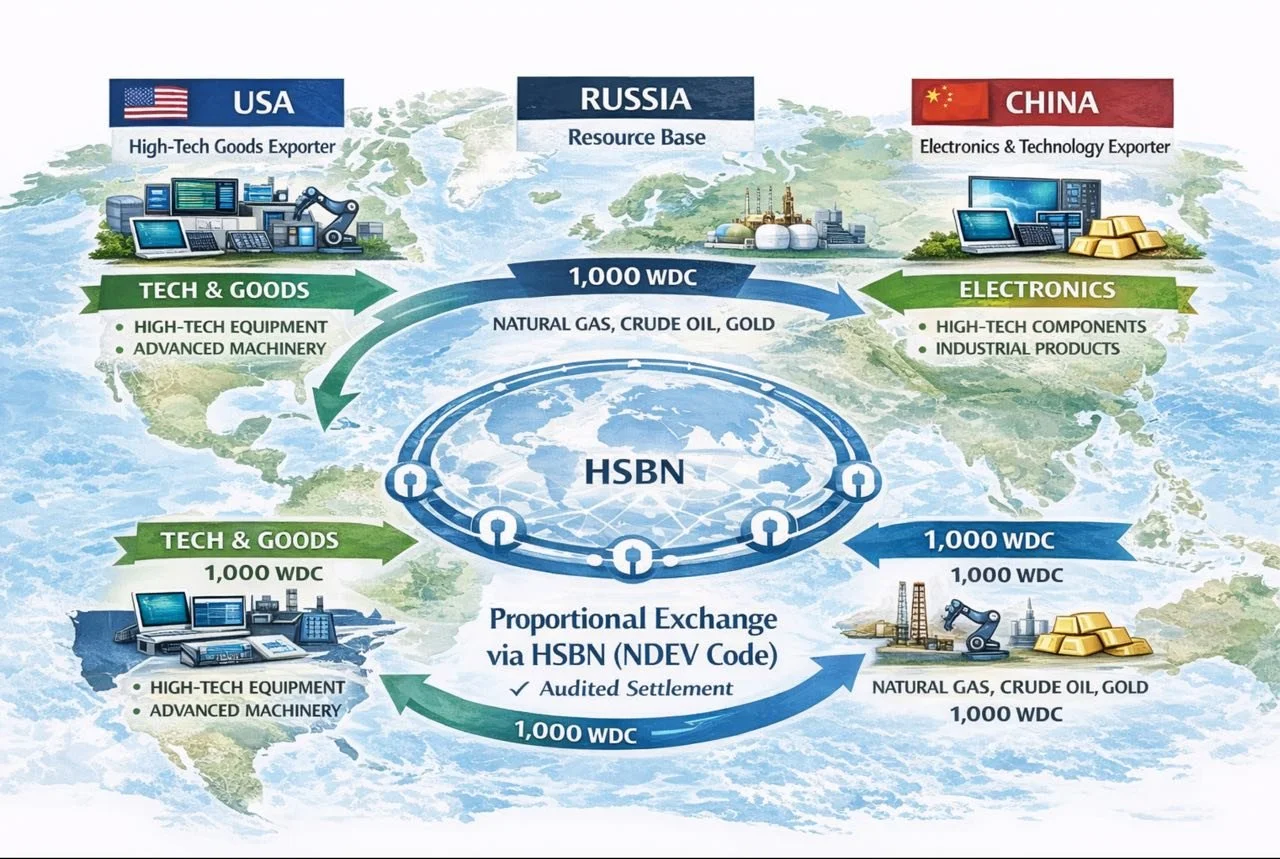
This section describes a worked technical pilot example using a Gold-only National Equivalent of Value (AU-NEV) across multiple large territories. The pilot is illustrative and analytical, demonstrating how sovereign, geolocated value anchors can interoperate within HSBN without introducing a hegemonic pricing currency.
The example does not prescribe political alignment or implementation. It serves to validate interoperability, custody separation, clearing logic, and expansion pathways under a shared NEV framework.
A) Purpose of the Worked Pilot
The pilot example is constructed to:
· limit complexity by using Gold as the sole NEV anchor,
· stress-test custody, audit, geography, and clearing across large territories,
· demonstrate interoperability without redesign,
· preserve openness for additional participants and alternative NEVs.
The example is technical in nature and does not constitute geopolitical advocacy.
B) Participating Territories (Illustrative)
The pilot considers three territories as illustrative cases:
· United States
· Russia
· China
For each territory:
· AU-NEV is declared independently,
· gold remains under national custody,
· no physical gold movement occurs for settlement,
· settlement operates through claim clearing only.
C) Declared NEVs (Gold-Only)
For each territory TTT:
· NEV Class: AU-NEV
· Quantity: declared eligible gold (metric units, audited)
· Custody: geofenced national vaults
· Audit: independent, periodic
· Issuance Constraint:
· SupplyT≤αT⋅NEVT,AUeligibleSupply_T \le \alpha_T \cdot NEV_{T,AU}^{eligible}SupplyT≤αT⋅NEVT,AUeligible
Each NEV remains sovereign, audited, and geographically anchored.
D) HSBN Clearing (Gold-Only)
D.1 Clearing Object
Settlement clears claims, not physical gold. Each settlement references:
· AU-NEV class,
· signed snapshot hash,
· settlement window.
D.2 Clearing Ratios
· derived from eligible gold snapshots only,
· calculated per settlement window,
· no fixed peg or hegemonic price.
D.3 Structural Effects
The model removes:
· reserve-currency weaponisation,
· unconstrained abstract issuance,
· hidden leverage via exclusive settlement rails.
E) Expansion Path
E.1 Joining with Gold
Any additional territory may join by:
· declaring AU-NEV,
· publishing geofenced custody,
· attaching audits,
· publishing snapshots,
· clearing through HSBN settlement windows.
No permission from existing participants is required.
E.2 Joining with Alternative NEVs
Territories may later declare additional NEVs (e.g., energy, materials) using:
· the same registry structures,
· the same audit logic,
· the same geofence constraints.
Gold remains a common reference anchor, not an exclusive standard.
F) Pilot Artefacts
For each participating territory, the pilot is fully represented by:
1. NEV_DECLARATION.yaml (AU-NEV only)
2. NEV_GEOFENCE.geojson (custody locations)
3. NEV_SNAPSHOT_<date>.json
4. AUDIT_<anchor>_<date>.zip
5. HSBN_SETTLEMENT_EXAMPLE.json
These artefacts are sufficient to represent the pilot state.
G) NDEV Token — Pilot Profile (Gold-Based)
The pilot assumes an NDEV Token profile with the following properties:
· anchor-referenced (AU-NEV only),
· metric units (grams),
· snapshot-bound validity,
· geofence-aware,
· divisible and non-abstract.
Associated internal specifications include:
· NDEV Code — issuance constraint logic,
· NDEV Token — anchor lineage schema,
· HSBN — settlement envelope validation.
These references describe protocol components, not financial instruments.
H) Summary Statement
NEV v1.8 presents a Gold-only worked pilot across multiple territories as a technical demonstration of how sovereign, geolocated value anchors can interoperate within HSBN without reliance on a hegemonic currency. Settlement clears claims rather than physical assets, while expansion remains open to additional participants declaring Gold or alternative NEVs under the same audit- and geography-based constraints.
Executive Summary (Archive)
Ramsmile / NDEV Code (2019–2025) is an analytical body of work examining alternative approaches to money, value representation, and global settlement, with particular focus on systemic debt dynamics and the structural incentives associated with large-scale conflict.
The work begins from the observation that contemporary monetary systems are largely abstracted from geography, physical resources, and delivery constraints. This abstraction enables unbounded debt expansion, financial leverage through settlement control, and recurring conflict around currencies, trade routes, and access to resources.
The archive documents an alternative analytical framework based on National Equivalents of Value (NEVs) and NDEV Code, in which value is:
· declared at the territorial level,
· anchored to auditable real-world assets (initially gold, with extensions to energy and resources),
· geolocated and subject to custody and audit constraints, and
· used for settlement within formally defined issuance limits.
Rather than proposing a single global currency, the framework describes interoperable settlement through a neutral transaction network (HSBN), where settlement clears claims while underlying assets remain under sovereign custody. Participation is voluntary, non-exclusive, and structurally expandable.
Between 2019 and 2025, the work developed:
· a coherent conceptual architecture,
· technical artefact definitions for tokenisation and settlement,
· governance, security, and failure-mode analyses,
· and a worked pilot example (gold-only, multi-territory) illustrating how such a system could operate without monetary domination.
The archive does not advocate policy adoption or action. It records a testable analytical proposition: that anchoring monetary settlement to audited, geolocated value can constrain debt growth and reduce structural incentives for large-scale conflict, while preserving sovereignty, markets, and trade.
This material is preserved as a completed analytical construct, intended for inspection, critique, or future reuse by researchers, engineers, and institutions.
Indicative NEV Normalisation Table
Reference date: 2026-01-07
Assumption: 1 WDC = 1 kg Gold (AU-NEV)
(Status: analytical normalisation reference, non-market)
---------------------------------------------------------------------------------------------
NEV Anchor Type | Physical Unit | Approx. vs 1 kg Gold | WDC Expression | Notes
---------------------------------------------------------------------------------------------
Gold (AU-NEV) | 1 kg | Baseline | 1.000 WDC | Primary anchor, reference etalon
Natural Gas (GAS-NEV) | 1,000 m³ | ~0.03–0.05 kg gold | 0.03–0.05 WDC | Geography- and infrastructure-dependent
Crude Oil (OIL-NEV) | 1 barrel (~159 L) | ~0.002–0.003 kg gold | 0.002–0.003 WDC| Quality, transport, deliverability haircuts
Electricity (ELEC-NEV) | 1 MWh (firm capacity) | ~0.0007–0.001 kg gold| 0.0007–0.001 WDC| Dispatchable capacity only
Coal (COAL-NEV) | 1 tonne | ~0.001–0.002 kg gold | 0.001–0.002 WDC| Environmental and logistics haircuts
Uranium (U-NEV) | 1 kg U₃O₈ equivalent | ~0.015–0.03 kg gold | 0.015–0.03 WDC | Strategic resource, strict eligibility
Hydrogen (H2-NEV) | 1 kg (green) | ~0.0003–0.0006 kg gold|0.0003–0.0006 WDC| Energy-density and production-cost sensitive
Industrial Capacity | 1 MW-year (firm capacity) | ~0.01–0.02 kg gold | 0.01–0.02 WDC | Capacity-based NEV, not energy volume
---------------------------------------------------------------------------------------------
Clarifications (Canonical Notes)
· The values above are analytical normalisation ratios, not market prices and not forecasts.
· NEVs are not freely convertible currencies; settlement occurs proportionally within HSBN using audit status, geolocation, infrastructure constraints, and time windows.
· Final WDC expressions depend on haircuts, deliverability, infrastructure capacity, and audit quality.
· Gold functions as a normalisation anchor, not as an exclusive or monopolistic representation of value.
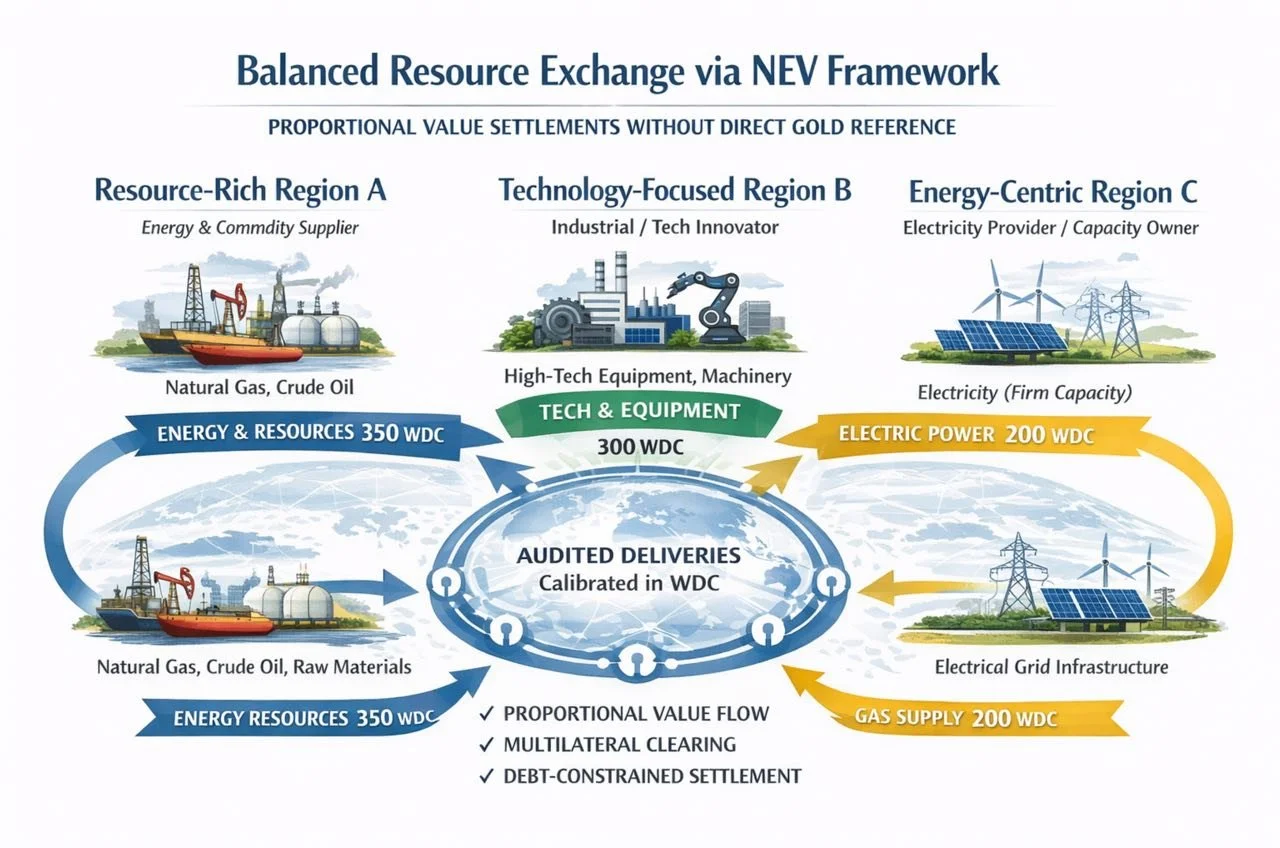
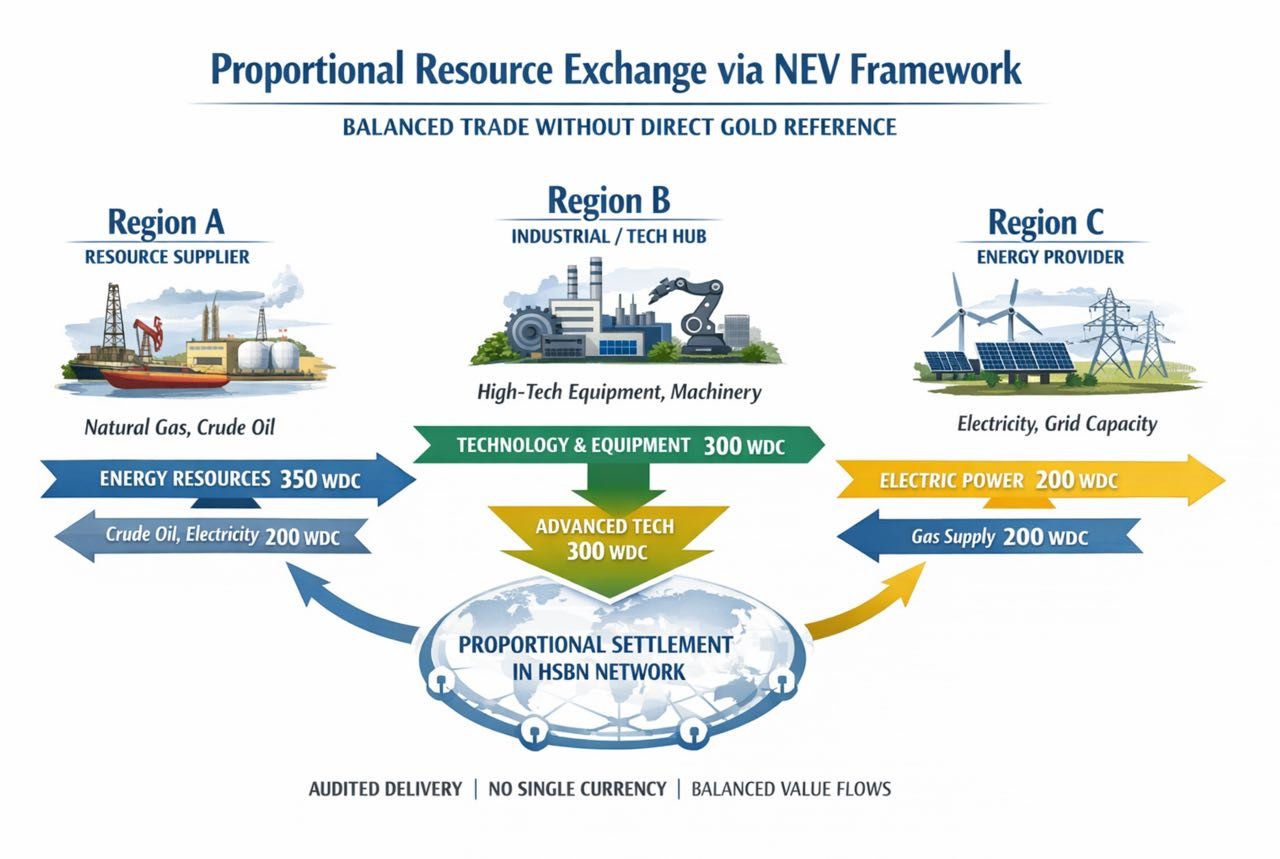
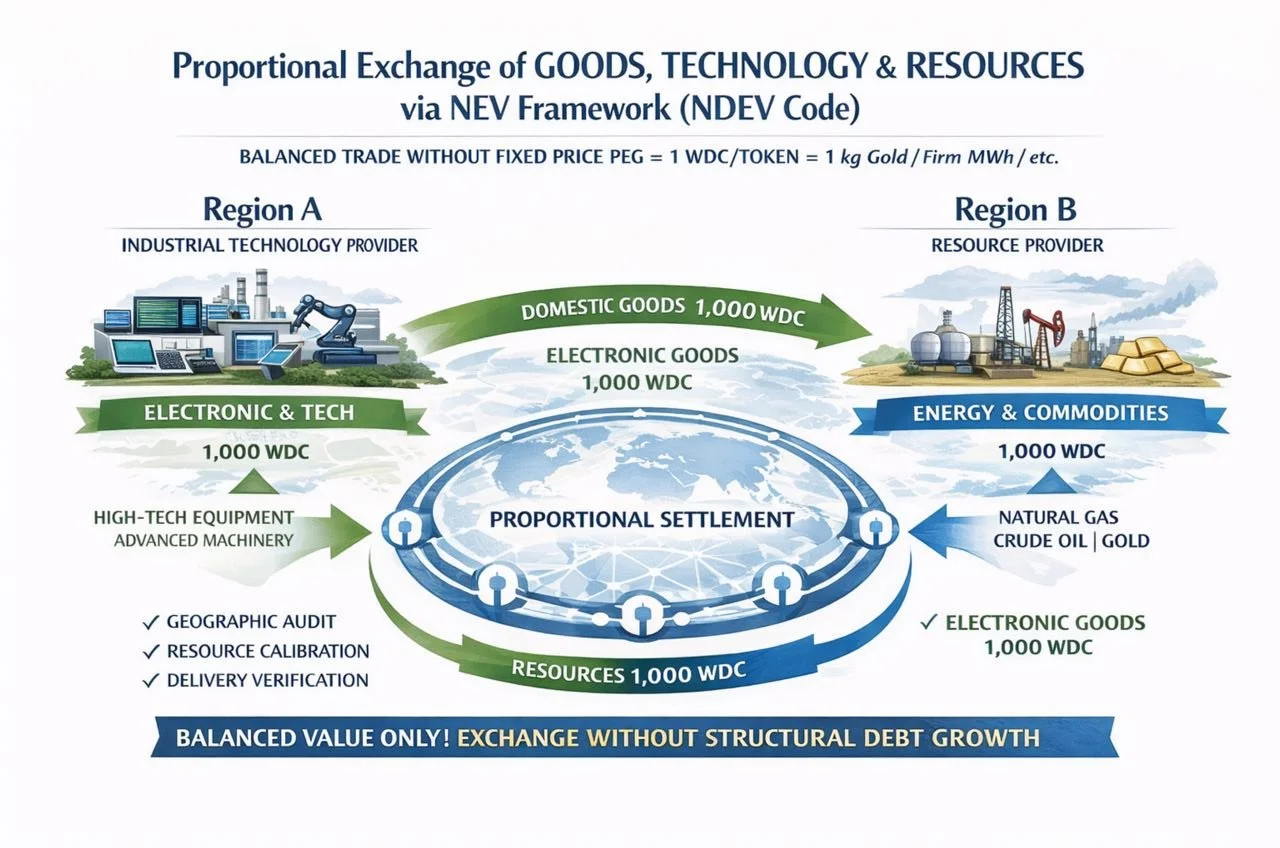
Proportional Exchange via NEVs
(Gold as Calibration Anchor Only)
Gold functions exclusively as a background calibration anchor for NEVs. It does not appear as a traded or exchanged asset within settlement flows.
Analytical Assumptions
· WDC functions as a normalisation unit, not as a traded commodity.
· Each region settles using its declared NEVs.
· Exchange is proportional, based on audited and deliverable value.
· No fixed prices exist; ratios are computed per settlement window.
Regions and Declared Strengths (Simplified)
---------------------------------------------- Region | Dominant NEVs
---------------------------------------------- Region A | Natural Gas, Crude Oil Region B | Industrial Technology, Manufacturing Capacity Region C | Electricity (firm), Grid Capacity
----------------------------------------------
Proportional Exchange Table (Illustrative)
Settlement Window: Q1 / 2026
Normalisation Unit: WDC (internal accounting reference only)
---------------------------------------------------------------------------------------------------------
From Region | To Region | Delivered Item | Quantity | Normalised Value | Received Item | Quantity
---------------------------------------------------------------------------------------------------------
Region A | Region B | Natural Gas | 10,000,000 m³ | 350 WDC | Industrial Equipment | Equivalent batch
Region B | Region C | Industrial Technology | 1 production line | 300 WDC | Electricity (firm) | 300 MWh
Region C | Region A | Electricity (firm) | 200 MWh | 200 WDC | Crude Oil | ~70 barrels
---------------------------------------------------------------------------------------------------------
Net Effect | | Resources ↔ Technology ↔ Energy | Balanced | No gold involved |
---------------------------------------------------------------------------------------------------------
Exchange Logic (Declarative Explanation)
· Region A delivers natural gas, which is audited, geolocated, and normalised into WDC units.
· Region B delivers industrial technology, normalised under the same framework.
· Region C delivers firm electricity capacity, likewise normalised.
· HSBN clears these flows proportionally using WDC as a common measurement reference, not as a store of abstract value.
Gold does not appear in settlement transactions.
Structural Interpretation
· Physical flows follow infrastructure constraints.
· Value flows are bounded by deliverability and audit status.
· No single currency dominates settlement.
· Geographic reality remains visible within the clearing process.
Comparison of Exchange Models
------------------------------------------------------------- Fiat / Pricing-Currency System | NEV / WDC Proportional System
------------------------------------------------------------- Single pricing currency | Multiple declared NEVs Abstract money | Geolocated value Debt-driven imbalance | Delivery-bounded exchange Resource conflicts incentivised| Resource exchange incentivised
-------------------------------------------------------------
Summary Statement (Canonical Form)
Within the NEV framework, regions exchange resources, technology, and energy proportionally using WDC as a neutral unit of account. Value is normalised from audited, geolocated deliverables rather than abstract money, allowing heterogeneous assets such as gas, electricity, and industrial capacity to clear directly through HSBN. Gold remains a calibration anchor only and does not function as a traded medium, reducing dependency on hegemonic currencies and limiting conflict incentives associated with currency control.
Part 2 — NEV World Economy
System-level analysis of how NEVs interact across territories and economic regions.
Analytical Framework: Incentive Reduction for Large-Scale War
(NEV / NDEV Code / HSBN Settlement Model)
This section presents a formal analytical framework demonstrating that, under explicitly stated assumptions, a settlement architecture based on NEV-anchored issuance, NDEV Code constraints, and HSBN clearing reduces the economic incentives for large-scale war relative to a hegemonic pricing-currency system.
The result is expressed as a conditional theorem about incentives and equilibria, not as a prediction or guarantee of peace.
1) Model Definition (Minimal and Explicit)
Players:
Let i∈{U,C,R}i \in \{U, C, R\}i∈{U,C,R} denote three large territories (illustrative): United States, China, Russia.
Actions:
In each period ttt, player iii chooses
ait∈{P,E}a_i^t \in \{P, E\}ait∈{P,E}
where:
· PPP: peace / normal trade and settlement
· EEE: escalation (sanctions, blockade, proxy conflict, or kinetic action)
Per-period utility:
ui(at)=Bi(trade)−Ki(at)+Gi(at)u_i(a^t) = B_i(\text{trade}) - K_i(a^t) + G_i(a^t)ui(at)=Bi(trade)−Ki(at)+Gi(at)
where:
· Bi(trade)B_i(\text{trade})Bi(trade): benefit from trade and settlement,
· Ki(at)K_i(a^t)Ki(at): direct and indirect cost of escalation,
· Gi(at)G_i(a^t)Gi(at): geopolitical rent from escalation (currency leverage, settlement exclusion, forced repricing).
2) Two Settlement Regimes
Regime H (hegemonic settlement rails):
Pricing currency and settlement rails enable large coercive rents.
Regime N (NEV / NDEV / HSBN):
Settlement is NEV-anchored, geofenced, audited, and cleared in time windows; coercive rents are structurally reduced.
Formally, for escalation EEE:
Gi(N)(E)≤(1−λ) Gi(H)(E),λ∈(0,1]G_i^{(N)}(E) \le (1-\lambda)\, G_i^{(H)}(E), \quad \lambda \in (0,1]Gi(N)(E)≤(1−λ)Gi(H)(E),λ∈(0,1]
where λ\lambdaλ is the rent-removal factor induced by loss of pricing-currency monopoly, settlement exclusion power, and unlimited leverage.
In addition, escalation under Regime N disrupts the settlement system relied upon by all participants, increasing costs:
Ki(N)(E)≥Ki(H)(E)+Δi,Δi>0K_i^{(N)}(E) \ge K_i^{(H)}(E) + \Delta_i, \quad \Delta_i > 0Ki(N)(E)≥Ki(H)(E)+Δi,Δi>0
where Δi\Delta_iΔi is the self-harm premium.
3) One-Shot Incentive Result
Escalation is individually rational in a one-shot interaction when:
Gi(E)−Ki(E)>0G_i(E) - K_i(E) > 0Gi(E)−Ki(E)>0
Under Regime N:
Gi(N)(E)−Ki(N)(E)≤(1−λ)Gi(H)(E)−(Ki(H)(E)+Δi)G_i^{(N)}(E) - K_i^{(N)}(E) \le (1-\lambda)G_i^{(H)}(E) - \big(K_i^{(H)}(E)+\Delta_i\big)Gi(N)(E)−Ki(N)(E)≤(1−λ)Gi(H)(E)−(Ki(H)(E)+Δi)
Escalation ceases to be rational whenever:
(1−λ)Gi(H)(E)≤Ki(H)(E)+Δi(1-\lambda)G_i^{(H)}(E) \le K_i^{(H)}(E) + \Delta_i(1−λ)Gi(H)(E)≤Ki(H)(E)+Δi
This defines a strictly smaller parameter region in which escalation is incentive-compatible compared to Regime H.
4) Repeated Game Result (Sustainability of Peace)
Consider an infinite repeated game with discount factor δ∈(0,1)\delta \in (0,1)δ∈(0,1).
Let:
· ViPV_i^PViP: expected discounted value under continued peace,
· VibreakV_i^{\text{break}}Vibreak: value after breakdown.
Peace is sustainable if:
Γi≤δLi\Gamma_i \le \delta L_iΓi≤δLi
where:
· Γi=ui(E,P−i)−ui(P,P−i)\Gamma_i = u_i(E,P_{-i}) - u_i(P,P_{-i})Γi=ui(E,P−i)−ui(P,P−i) is the one-period deviation gain,
· Li=ViP−VibreakL_i = V_i^P - V_i^{\text{break}}Li=ViP−Vibreak is the long-run loss.
NEV effects:
· Deviation gain shrinks:
Γi(N)≤(1−λ)Γi(H)−Δi\Gamma_i^{(N)} \le (1-\lambda)\Gamma_i^{(H)} - \Delta_iΓi(N)≤(1−λ)Γi(H)−Δi
· Long-run loss increases due to higher value of stable clearing:
Li(N)≥Li(H)+Ωi,Ωi>0L_i^{(N)} \ge L_i^{(H)} + \Omega_i, \quad \Omega_i > 0Li(N)≥Li(H)+Ωi,Ωi>0
Thus the peace condition becomes easier to satisfy under Regime N:
Γi(N)≤δLi(N)\Gamma_i^{(N)} \le \delta L_i^{(N)}Γi(N)≤δLi(N)
5) Application to High-Cost Kinetic War
For kinetic war between large powers, escalation costs Ki(E)K_i(E)Ki(E) are large.
Under NEV / HSBN settlement:
· coercive rents are reduced (λ↑\lambda \uparrowλ↑),
· self-harm costs increase (Δ↑\Delta \uparrowΔ↑),
· value of continued cooperation increases (Ω↑\Omega \uparrowΩ↑).
As a result:
(1−λ)G(H)(E)−(K(H)(E)+Δ)≪0(1-\lambda)G^{(H)}(E) - (K^{(H)}(E)+\Delta) \ll 0(1−λ)G(H)(E)−(K(H)(E)+Δ)≪0
making kinetic escalation less incentive-compatible than under hegemonic settlement regimes.
6) Theorem (Formal Statement)
Theorem (Incentive Reduction for Large-Scale War under NEV-Anchored Settlement).
Assume:
1. Escalation rents are reduced by factor λ>0\lambda>0λ>0:
G(N)(E)≤(1−λ)G(H)(E)G^{(N)}(E)\le(1-\lambda)G^{(H)}(E)G(N)(E)≤(1−λ)G(H)(E)
1. Escalation costs increase by Δ>0\Delta>0Δ>0:
K(N)(E)≥K(H)(E)+ΔK^{(N)}(E)\ge K^{(H)}(E)+\DeltaK(N)(E)≥K(H)(E)+Δ
1. The value of continued peace increases by Ω>0\Omega>0Ω>0:
L(N)≥L(H)+ΩL^{(N)}\ge L^{(H)}+\OmegaL(N)≥L(H)+Ω
Then:
· the parameter region in which escalation is rational in a one-shot game is strictly smaller under Regime N than under Regime H;
· the set of discount factors δ\deltaδ for which peace is a subgame perfect equilibrium in the repeated game is strictly larger under Regime N.
Therefore, large-scale war incentives are formally reduced under NEV-anchored, HSBN-cleared settlement.
7) Scope Limitation
This analysis:
· does not claim elimination of conflict,
· does not predict political decisions,
· demonstrates only that economic incentives and equilibrium conditions shift away from large-scale war under the stated assumptions.
Analytical Framework: Adoption Dynamics of NEV / NDEV / HSBN Settlement
(Threshold Cascade and Replicator Dynamics Models)
This section formalises how adoption of a NEV / NDEV Code / HSBN settlement framework could become self-reinforcing under explicit assumptions. The results are conditional statements about incentives and equilibria; they do not guarantee adoption outcomes.
1) Discrete Threshold-and-Cascade Model
Let each country iii choose between two strategies:
· JJJ: join the HSBN/NEV settlement framework
· SSS: remain on legacy settlement rails
Let:
· nnn = number of countries that have joined,
· NNN = total number of countries,
· q=n/N∈[0,1]q = n/N \in [0,1]q=n/N∈[0,1] = adoption fraction.
Define the net payoff advantage of joining as:
Δi(q)≡Ui(J∣q)−Ui(S∣q)\Delta_i(q) \equiv U_i(J \mid q) - U_i(S \mid q)Δi(q)≡Ui(J∣q)−Ui(S∣q)
Decompose:
Δi(q)=Bi(q)+Ri(q)−Ci−Pi(q)\Delta_i(q) = B_i(q) + R_i(q) - C_i - P_i(q)Δi(q)=Bi(q)+Ri(q)−Ci−Pi(q)
where:
· Bi(q)B_i(q)Bi(q): network/trade benefit from adoption (access to corridors/partners),
· Ri(q)R_i(q)Ri(q): reduced coercion / reduced rail-exclusion exposure as adoption grows,
· CiC_iCi: transition and implementation cost (bounded, largely one-off),
· Pi(q)P_i(q)Pi(q): political/strategic penalty term.
A country joins iff:
Δi(q)≥0\Delta_i(q) \ge 0Δi(q)≥0
Assumptions (Monotone Benefits)
1. Bi′(q)>0B_i'(q) > 0Bi′(q)>0 (network benefit increases with adoption)
2. Ri′(q)>0R_i'(q) > 0Ri′(q)>0 (coercion/rail leverage declines as adoption grows)
3. CiC_iCi is bounded and largely one-off
4. Pi′(q)≤Bi′(q)+Ri′(q)P_i'(q) \le B_i'(q)+R_i'(q)Pi′(q)≤Bi′(q)+Ri′(q) (penalties do not grow faster than benefits; may decline via “safety in numbers”)
Under these assumptions, for many countries there exists a joining threshold qi\*q_i^\*qi\* such that:
· if q≥qi\*q \ge q_i^\*q≥qi\*, then Δi(q)≥0\Delta_i(q) \ge 0Δi(q)≥0 and country iii joins;
· if q<qi\*q < q_i^\*q<qi\*, then country iii stays out.
Define:
F(q)=1N∣{i:qi\*≤q}∣F(q) = \frac{1}{N}\left|\{i : q_i^\* \le q\}\right|F(q)=N1{i:qi\*≤q}
as the fraction of countries whose threshold is at most qqq. Adoption evolves as:
qt+1=F(qt)q_{t+1} = F(q_t)qt+1=F(qt)
A positive feedback (“cascade”) region exists on any interval where:
F(q)>qfor q∈(q0,q1)F(q) > q \quad \text{for } q \in (q_0, q_1)F(q)>qfor q∈(q0,q1)
In such a region, adoption increases whenever it enters the interval and converges to a fixed point q\*q^\*q\* satisfying F(q\*)=q\*F(q^\*)=q^\*F(q\*)=q\*.
2) Continuous-Time Replicator Dynamics Model
Let q(t)∈[0,1]q(t)\in[0,1]q(t)∈[0,1] be the fraction of countries that have joined at time ttt. Let expected payoffs be:
· πJ(q)\pi_J(q)πJ(q): payoff to joining at adoption level qqq
· πS(q)\pi_S(q)πS(q): payoff to staying out at adoption level qqq
Define payoff advantage:
Δ(q)≡πJ(q)−πS(q)\Delta(q) \equiv \pi_J(q) - \pi_S(q)Δ(q)≡πJ(q)−πS(q)
Replicator dynamics:
q˙=q(1−q) Δ(q)\dot q = q(1-q)\,\Delta(q)q˙=q(1−q)Δ(q)
Interpretation:
· if Δ(q)>0\Delta(q)>0Δ(q)>0, then q˙>0\dot q>0q˙>0 and adoption grows,
· if Δ(q)<0\Delta(q)<0Δ(q)<0, then q˙<0\dot q<0q˙<0 and adoption declines.
Decompose:
Δ(q)=B(q)+R(q)−C−P(q)\Delta(q) = B(q) + R(q) - C - P(q)Δ(q)=B(q)+R(q)−C−P(q)
with analogous meanings to the discrete model.
Mild assumptions consistent with the NEV/HSBN design
1. B′(q)>0B'(q) > 0B′(q)>0
2. R′(q)>0R'(q) > 0R′(q)>0
3. C>0C>0C>0 bounded
4. P′(q)≤0P'(q) \le 0P′(q)≤0 or small relative to B′(q)+R′(q)B'(q)+R'(q)B′(q)+R′(q)
Then typically:
Δ′(q)=B′(q)+R′(q)−P′(q)>0\Delta'(q) = B'(q)+R'(q)-P'(q) > 0Δ′(q)=B′(q)+R′(q)−P′(q)>0
Critical mass and stability
If:
· Δ(0)<0\Delta(0) < 0Δ(0)<0 (early adoption unattractive),
· Δ(1)>0\Delta(1) > 0Δ(1)>0 (near-universal adoption attractive),
then by continuity there exists a unique qc∈(0,1)q_c \in (0,1)qc∈(0,1) such that:
Δ(qc)=0\Delta(q_c)=0Δ(qc)=0
Equilibria occur at q=0q=0q=0, q=qcq=q_cq=qc, and q=1q=1q=1.
Proposition (Replicator stability under Δ′(q)>0\Delta'(q)>0Δ′(q)>0):
· q=0q=0q=0 is stable if Δ(0)<0\Delta(0)<0Δ(0)<0
· q=1q=1q=1 is stable if Δ(1)>0\Delta(1)>0Δ(1)>0
· qcq_cqc is unstable (tipping point)
Proof sketch (1D sign argument):
· near q=0q=0q=0: q˙≈q Δ(0)\dot q \approx q\,\Delta(0)q˙≈qΔ(0), so if Δ(0)<0\Delta(0)<0Δ(0)<0, trajectories return to 0;
· near q=1q=1q=1: letting x=1−qx=1-qx=1−q, x˙≈−x Δ(1)\dot x \approx -x\,\Delta(1)x˙≈−xΔ(1), so if Δ(1)>0\Delta(1)>0Δ(1)>0, trajectories converge to 1;
· at qcq_cqc: Δ′(qc)>0\Delta'(q_c)>0Δ′(qc)>0 implies Δ(q)>0\Delta(q)>0Δ(q)>0 for q>qcq>q_cq>qc and Δ(q)<0\Delta(q)<0Δ(q)<0 for q<qcq<q_cq<qc, so trajectories move away from qcq_cqc.
This formalises a tipping dynamic: below qcq_cqc, adoption decays; above qcq_cqc, adoption grows toward a high-adoption equilibrium.
3) Scope Limitation
These models:
· do not guarantee adoption,
· do not predict political shocks,
· demonstrate only that adoption can become an equilibrium attractor under explicit monotonicity and bounded-cost assumptions.
Analytical Framework: When Non-Gold NEVs Dominate Gold
(Fitness Model, Dominance Conditions, and Replacement Criteria)
This section formalises why Gold (AU-NEV) can function as an initial calibration anchor while other NEVs (energy, electricity, productive capacity, and potentially territory-use rights) can become dominant over time. Results are conditional on stated assumptions and do not constitute prediction.
1) Role of Gold as a Transitional Anchor
Define an NEV anchor class kkk with measurable property components:
Pk(t)=(Sk, Lk, Dk, Uk(t))\mathbf{P}_k(t) = \big(S_k,\; L_k,\; D_k,\; U_k(t)\big)Pk(t)=(Sk,Lk,Dk,Uk(t))
Where:
· SkS_kSk: stability of the anchor basis (e.g., low variance, high stock-to-flow characteristics)
· LkL_kLk: liquidity and measurement tractability (standardisation, metrology, verifiability)
· DkD_kDk: deliverability/settleability under audited infrastructure constraints
· Uk(t)U_k(t)Uk(t): utility relevance to survival and production at time ttt
Gold typically scores high on SkS_kSk, LkL_kLk, and custody-audit tractability, but has limited direct utility in life-support and production terms compared to energy and capacity anchors:
Ugold(t)≪Uenergy(t), Uelectricity(t), Ucapacity(t)U_{\text{gold}}(t) \ll U_{\text{energy}}(t),\; U_{\text{electricity}}(t),\; U_{\text{capacity}}(t)Ugold(t)≪Uenergy(t),Uelectricity(t),Ucapacity(t)
Thus, gold is suitable as a calibration anchor in early phases where stability and measurement dominate weighting, but not necessarily as the long-run dominant NEV.
2) Systemic Fitness Function
Define a system-level “fitness” score for anchor kkk:
Fk(t)=α(t)Sk+β(t)Lk+γ(t)Dk+δ(t)Uk(t)F_k(t)=\alpha(t)S_k+\beta(t)L_k+\gamma(t)D_k+\delta(t)U_k(t)Fk(t)=α(t)Sk+β(t)Lk+γ(t)Dk+δ(t)Uk(t)
with weights:
α(t)+β(t)+γ(t)+δ(t)=1,α,β,γ,δ∈[0,1]\alpha(t)+\beta(t)+\gamma(t)+\delta(t)=1,\quad \alpha,\beta,\gamma,\delta \in [0,1]α(t)+β(t)+γ(t)+δ(t)=1,α,β,γ,δ∈[0,1]
Key assumption (explicit): over long horizons, the weight on utility for survival/production increases:
dδ(t)dt>0\frac{d\delta(t)}{dt} > 0dtdδ(t)>0
This captures a structural shift where settlement relevance is increasingly tied to deliverable necessities (energy, firm power, productive capacity) rather than inert stores of value.
3) Dominance-Crossing Condition
Assume gold utility is approximately time-invariant relative to necessities:
dUgold(t)dt≈0\frac{dU_{\text{gold}}(t)}{dt}\approx 0dtdUgold(t)≈0
while for at least one necessity-based anchor mmm (e.g., electricity or energy):
dUm(t)dt>0\frac{dU_m(t)}{dt} > 0dtdUm(t)>0
Then there exists a crossing time t\*t^\*t\* (possibly finite) such that:
Fm(t\*)>Fgold(t\*)F_m(t^\*) > F_{\text{gold}}(t^\*)Fm(t\*)>Fgold(t\*)
This is a dominance-crossing result: if the utility term becomes sufficiently weighted and increases for necessity-based anchors, then those anchors eventually exceed gold in systemic fitness.
Gold remains dominant only while:
αSgold+βLgold+γDgold outweighs δ(t)(Um(t)−Ugold(t))\alpha S_{\text{gold}} + \beta L_{\text{gold}} + \gamma D_{\text{gold}} \;\;\text{outweighs}\;\; \delta(t)\big(U_m(t)-U_{\text{gold}}(t)\big)αSgold+βLgold+γDgoldoutweighsδ(t)(Um(t)−Ugold(t))
4) Which NEVs Replace Gold First (Model Criterion)
A non-gold anchor mmm replaces gold in dominance when it satisfies both:
1. Fitness dominance: Fm(t)>Fgold(t)F_m(t) > F_{\text{gold}}(t)Fm(t)>Fgold(t)
2. Constraint feasibility: deliverability/auditability remains high enough for settlement use:
Dm≥DminandAuditability(m)≥AminD_m \ge D_{\min} \quad \text{and} \quad \text{Auditability}(m)\ge A_{\min}Dm≥DminandAuditability(m)≥Amin
Under NEV/HSBN framing, candidate anchors that often meet the feasibility condition better than “technology” or “IP” include:
· ELEC-NEV (firm capacity): measurable, node-bound, infrastructure-constrained, time-window deliverable
· Energy deliverables (OIL-NEV, GAS-NEV, ELEC-NEV): anchored to infrastructure and corridor constraints
· Capacity-based NEVs (firm MW-year, throughput): deliverability constrained by real capacity and time
Technology/IP anchors can become relevant later but typically require stronger standardisation to meet auditability constraints.
5) Comparative Advantage of Electricity and Energy Anchors (Formal Notes)
Electricity and energy anchors tie value representation to necessities:
· gold: value largely independent of use in production/consumption flows
· energy/electricity: value coupled to survival and production constraints
Within a deliverability-bounded settlement architecture, an additional advantage of firm electricity capacity is that it is inherently infrastructure-bound, limiting unconstrained hoarding without associated storage and grid constraints. In model terms, this supports stronger bounds on abstract leverage by tightening DkD_kDk and corridor/window constraints at settlement.
6) Territory as a Potential Future Anchor Class (Boundary Conditions)
Territory-based anchors are better modelled as time-bounded usage rights (rent/lease constraints) rather than absolute ownership claims. A simplified representation:
TERR-NEV=⟨Area, Jurisdiction, Access Constraints, Time Window⟩\text{TERR-NEV} = \langle \text{Area},\ \text{Jurisdiction},\ \text{Access Constraints},\ \text{Time Window} \rangleTERR-NEV=⟨Area, Jurisdiction, Access Constraints, Time Window⟩
Its utility relevance may increase under scarcity:
dUterritory(t)dt>0under increasing land/resource constraints\frac{dU_{\text{territory}}(t)}{dt} > 0 \quad \text{under increasing land/resource constraints}dtdUterritory(t)>0under increasing land/resource constraints
However, feasibility requires strong legal standardisation and auditable registries to prevent manipulation. Thus, territory anchors are typically viable only after lower-risk anchors (gold, energy, electricity, capacity) have stabilised core settlement constraints.
7) Replacement “Time” as a Model Output, Not a Calendar Claim
The “time when other NEVs replace gold” is defined internally by the earliest t\*t^\*t\* satisfying:
Fm(t\*)>Fgold(t\*)andDm≥DminF_m(t^\*) > F_{\text{gold}}(t^\*) \quad \text{and} \quad D_m \ge D_{\min}Fm(t\*)>Fgold(t\*)andDm≥Dmin
Without selecting empirical trajectories for Uk(t)U_k(t)Uk(t) and weight functions α(t),β(t),γ(t),δ(t)\alpha(t),\beta(t),\gamma(t),\delta(t)α(t),β(t),γ(t),δ(t), no calendar-date prediction follows. The framework identifies the conditions under which replacement occurs.
Summary Statement (Canonical Form)
Gold can function as an initial NEV calibration anchor due to stability and measurement properties, but it has limited direct utility in survival and production compared to energy-, electricity-, and capacity-based anchors. In a multi-NEV settlement framework, if the weight assigned to utility relevance increases over time and deliverability-constrained anchors exhibit rising utility, then there exists a crossing time at which at least one non-gold NEV attains higher systemic fitness than gold. Under auditability and deliverability constraints, firm electricity and energy deliverables are typical candidates for early dominance, with capacity- and territory-use anchors becoming viable later under stronger standardisation.
1) Diagram — “Gold Lending Office (Post-Printing Economy)”
5
Diagram Description (Canonical, Non-Stereotypical)
Title (suggested):
“After Printing: Value Must Return with Weight”
Visual Composition
· A clean, neutral, futuristic public office (no national, ethnic, religious, or historical symbols).
· A single professional officer (gender-neutral appearance, uniform abstract, no insignia).
· On the desk:
· A digital scale
· A gold ingot icon rendered as a data-object, not jewelry or wealth symbolism.
· A transparent holographic notice reads:
“Gold Loan Issuance”
Condition:
Returned weight = Issued weight × (1 + 0.05 × years)
(No exceptions. No printing.)
· In the background:
· A muted world map with energy lines, grids, and corridors highlighted.
· Banknote imagery appears faded / crossed out (subtle, non-mocking).
Humour (Soft, Structural)
· A small side panel reads:
· “We used to print.
Now we weigh.”
This communicates humour without caricature, without leaders, and without stereotypes.
Meaning
· Gold is shown only as collateral, not currency.
· The joke is structural: debt must return heavier.
· Printing money is visually obsolete.
This diagram fits perfectly as:
· A transition illustration between fiat and constrained settlement
· A gentle visual anchor before introducing NEVs beyond gold
2) Analytical Section — Why Printing No Longer Works & What the Alternatives Are
2.1 Why “Printing Money” No Longer Produces Economic Benefit
In the current global system:
Debt Service ⇒ Requires Growth\text{Debt Service} \;\Rightarrow\; \text{Requires Growth}Debt Service⇒Requires GrowthGrowth ⇒ Requires Energy + Stability + Infrastructure\text{Growth} \;\Rightarrow\; \text{Requires Energy + Stability + Infrastructure}Growth⇒Requires Energy + Stability + Infrastructure
When infrastructure trust erodes (sanctions saturation, cable/pipeline attacks, corridor disruption):
Monetary Expansion ⇒ Higher Nominal Supply ⇒ Lower Real Output\text{Monetary Expansion} \;\Rightarrow\; \text{Higher Nominal Supply} \;\Rightarrow\; \text{Lower Real Output}Monetary Expansion⇒Higher Nominal Supply⇒Lower Real Output
Thus:
More Money ⇏ More Value\text{More Money} \;\not\Rightarrow\; \text{More Value}More Money⇒More Value
Instead:
· QE stops restoring confidence
· Debt monetisation accelerates fragmentation
· Currency weaponisation undermines its own credibility
This is not ideological; it is a saturation condition.
3) Structural Alternatives to NDEV Code–Based WDC (Comparative Analysis)
There are alternatives. They fall into four structural classes.
Alternative 1 — Bloc-Based Monetary Fragmentation
Examples
· Regional clearing blocs
· Bilateral barter-like trade
· BRICS-style settlement
Pros
· Reduces reliance on hegemonic rails
· Works temporarily
Cons
· Recreates dominance inside blocs
· No neutral anchor
· High political friction
· Still incentivises inter-bloc conflict
➡️ Plan B drifting toward Plan C
Alternative 2 — CBDCs + Capital Controls
Examples
· Programmable money
· Domestic settlement walls
Pros
· Short-term internal stability
· Improved state control
Cons
· No international neutrality
· Increases coercion rather than trust
· Scales surveillance, not exchange
➡️ Control replaces cooperation
Alternative 3 — Commodity Repricing Without Architecture
Examples
· Oil in non-USD currencies
· Gold accumulation without settlement logic
Pros
· Symbolic de-dollarisation
· Tactical leverage
Cons
· No audit-anchored settlement
· No debt resolution
· Price wars persist
➡️ Fragmentation without resolution
Alternative 4 — Technological Optimism
Examples
· AI growth outruns debt
· Green transition absorbs liabilities
Pros
· Politically attractive
· Avoids hard restructuring
Cons
· Time inconsistency
· Requires stability that no longer exists
· Energy and infrastructure constraints remain
➡️ Hope, not structure
4) Why NDEV / NEV Is Structurally Distinct (Analytical)
NDEV Code–based WDC is the only class that simultaneously:
· Removes pricing-currency monopoly
· Anchors value to deliverable resources
· Constrains issuance by geography and audit
· Enables exchange without trust, not because of trust
Formally:
· Reduces G(E)G(E)G(E): gain from coercion
· Increases Δ\DeltaΔ: self-harm from disruption
No other alternative does both.
5) Hard Boundary Condition (Explicit)
Even if structurally superior, NDEV does not imply:
· Timely adoption
· Elite willingness to lose discretion
· Avoidance of Plan C dynamics
History shows systems often prefer collapse over constraint.
One-Line Canonical Synthesis (Internal)
When sanctions fail and infrastructure becomes a target, economies stop optimising and start surviving; without neutral settlement architecture, all remaining paths converge toward coercion.
Comparative Analysis: Settlement Architecture Dominance Under Systemic Stress
(Hegemonic Rails vs Fragmentation vs NEV/NDEV/HSBN)
This section provides a brief mathematical framework comparing settlement architectures under conditions of debt stress, fragmented trade, and elevated escalation risk. Results are conditional on stated assumptions and do not guarantee adoption outcomes.
1) Architecture Set
Let states select a settlement architecture SSS from:
· SHS_HSH: hegemonic pricing currency / sanctionable settlement rails
· SBS_BSB: fragmented alternatives (blocs, CBDCs, bilateral clearing, barter-like settlement)
· SNS_NSN: NEV-anchored settlement using NDEV Code and HSBN (audited, geolocated, time-window clearing)
2) Utility Decomposition
Define per-period expected utility:
U(S)=B(S)−K(S)+G(S)U(S) = B(S) - K(S) + G(S)U(S)=B(S)−K(S)+G(S)
where:
· B(S)B(S)B(S): benefit from trade, growth, and predictable settlement,
· K(S)K(S)K(S): systemic cost (instability, crisis risk, escalation risk),
· G(S)G(S)G(S): coercive rent obtainable from leverage (exclusion, repricing power, rail weaponisation).
3) Structural Properties (Explicit)
Hegemonic rails SHS_HSH:
G(SH) high,K(SH) non-decreasing over timeG(S_H)\ \text{high},\quad K(S_H)\ \text{non-decreasing over time}G(SH) high,K(SH) non-decreasing over time
(rail/currency leverage remains profitable; debt and coercion incentives persist)
Fragmented alternatives SBS_BSB:
G(SB) moderate,K(SB) still highG(S_B)\ \text{moderate},\quad K(S_B)\ \text{still high}G(SB) moderate,K(SB) still high
(rent shifts into blocs or control layers rather than being removed; fragmentation increases friction)
NEV/NDEV/HSBN SNS_NSN:
G(SN) ↓,Kescalation(SN) ↑,B(SN) ↑G(S_N)\ \downarrow,\quad K_{\text{escalation}}(S_N)\ \uparrow,\quad B(S_N)\ \uparrowG(SN) ↓,Kescalation(SN) ↑,B(SN) ↑
(rent reduced by design; escalation damages the participant’s own settlement capacity; settlement bounded by deliverable value)
Formal constraints used:
G(SN)≤(1−λ) G(SH),λ>0G(S_N) \le (1-\lambda)\,G(S_H),\quad \lambda>0G(SN)≤(1−λ)G(SH),λ>0Kescalation(SN)=Kescalation(SH)+Δ,Δ>0K_{\text{escalation}}(S_N)=K_{\text{escalation}}(S_H)+\Delta,\quad \Delta>0Kescalation(SN)=Kescalation(SH)+Δ,Δ>0
4) Result A — Reduced Incentive for Escalation
Escalation is rational only if:
G−K>0G - K > 0G−K>0
Under SNS_NSN, escalation net benefit is bounded:
(1−λ)G(SH)−(K(SH)+Δ)<0(1-\lambda)G(S_H) - \big(K(S_H)+\Delta\big) < 0(1−λ)G(SH)−(K(SH)+Δ)<0
for a strictly larger parameter region than under SHS_HSH or SBS_BSB.
Implication: kinetic and grey-zone escalation becomes equilibrium-inferior under broader conditions when settlement rents are removed and self-harm penalties exist.
5) Result B — Debt Dynamics: Structural Cap vs Postponement
Let debt sustainability require that issuance does not exceed deliverable value growth.
· In SHS_HSH and many SBS_BSB variants: issuance remains loosely constrained → debt expansion is delayed or redistributed.
· In SNS_NSN: issuance is bounded by audited, geolocated NEVs:
D˙(t)≤V˙real(t)\dot D(t) \le \dot V_{\text{real}}(t)D˙(t)≤V˙real(t)
where D(t)D(t)D(t) is aggregate claims and Vreal(t)V_{\text{real}}(t)Vreal(t) is aggregate deliverable NEV value.
Implication: debt growth is structurally capped (bounded by real deliverables) rather than deferred.
6) Result C — Cooperation Stability in Repeated Interaction
In repeated interaction, cooperation is stable if:
Γ≤δL\Gamma \le \delta LΓ≤δL
where:
· Γ\GammaΓ: one-period deviation gain from coercion/escalation,
· LLL: discounted loss from settlement breakdown,
· δ\deltaδ: discount factor.
Under SNS_NSN:
· Γ\GammaΓ decreases (coercive rent suppressed),
· LLL increases (higher value of continued neutral settlement).
Implication: peaceful cooperation occupies a larger equilibrium basin under SNS_NSN than under SHS_HSH or SBS_BSB, under the stated assumptions.
7) Dominance Conclusion (Conditional)
For the same actors and comparable constraints:
U(SN)>U(SH),U(SN)>U(SB)U(S_N) > U(S_H),\quad U(S_N) > U(S_B)U(SN)>U(SH),U(SN)>U(SB)
over a wider range of realistic parameter values, because SNS_NSN simultaneously:
· suppresses coercive rent,
· bounds debt by deliverable value,
· makes escalation self-damaging.
This is a structural dominance statement conditional on implementation fidelity; it is not a guarantee of adoption.
Technical Note: Structural Superiority of NEV-Anchored Settlement
(Definitions, Assumptions, Lemmas)
Definitions
Definition 1 (NEV).
An NEV is a territorially declared, auditable, deliverable unit of value defined by physical constraints and geolocation.
Definition 2 (WDC).
WDC is a neutral unit of account used for proportional settlement across NEVs. WDC is not a freely issued store of abstract value.
Definition 3 (HSBN).
HSBN is a settlement network enabling time-windowed, corridor-bounded, and auditable clearing of NEV claims.
Definition 4 (Escalation Rent).
Escalation rent GGG is net gain obtainable from coercion (exclusion, repricing power, corridor disruption, settlement leverage).
Assumptions
A1. Issuance of settlement claims is bounded by deliverable NEV value.
A2. NEVs are auditable and geographically constrained.
A3. Disruption of shared settlement corridors harms participants proportionally.
A4. Actors maximise expected long-run utility.
Lemmas
Lemma 1 (Bounded Debt Growth).
D˙(t)≤V˙(t)\dot D(t) \le \dot V(t)D˙(t)≤V˙(t)
Debt/claims cannot grow faster than deliverable value under A1. ∎
Lemma 2 (Escalation Rent Suppression).
GNEV≤(1−λ)Ghegemonic,λ>0G_{\text{NEV}} \le (1-\lambda)G_{\text{hegemonic}},\quad \lambda>0GNEV≤(1−λ)Ghegemonic,λ>0
Coercive rent is reduced by design under auditable, corridor-bounded settlement. ∎
Lemma 3 (Self-Harm of Escalation).
Escalation increases the escalator’s cost by a positive penalty Δ>0\Delta>0Δ>0 due to disruption of its own settlement capacity under A2–A3. ∎
Theorem
Theorem (Structural Dominance).
Given A1–A4, an NEV-anchored settlement system yields lower equilibrium incentives for large-scale conflict and greater long-run debt stability than hegemonic or fragmented alternatives. ∎
Remark
This note establishes structural properties (incentive and stability shifts) rather than predictions. Adoption depends on external choice; dominance follows from constraints.
Definitions
Definition 1 — NEV (National Equivalent of Value, Declared Etalon of Value)
An NEV is a territorially declared, auditable, and deliverable value anchor class defined by physical constraints and jurisdictional scope. Examples include gold mass, firm electricity capacity at a node, deliverable gas volume through a corridor, or audited productive capacity.
Geolocation-defined means: the NEV is defined by and within a declared territory of jurisdiction where the underlying resources exist and are registered. The “territory” may be:
· equal to a state’s border, or
· a sub-territory (a declared settlement zone) within a state’s jurisdiction.
Definition 2 — WDC (World Digital Currency)
WDC is a neutral unit of account used solely for proportional settlement and normalisation across NEVs and NIWs. WDC is:
· not a commodity,
· not a store of abstract value,
· not freely issued independent of registered value.
Definition 3 — NIW (National Item of Wealth)
A NIW is an individual, registrable item of wealth associated with a territory of jurisdiction and recorded with identity, state, and geolocation envelope parameters. NIWs may be:
· durable (e.g., a gold bar, a machine),
· consumable (e.g., fuel),
· time-bound deliverables (e.g., electricity delivered during a window).
NIWs can degrade, be consumed, or be destroyed; their expressed value in WDC can therefore decrease toward zero as verified by audits.
Definition 4 — HSBN (Highly Scalable Blockchain Network)
HSBN is a transaction and clearing network for NDEV Code objects and records. It supports settlement of NIW/NEV-referenced exchanges using:
· time-windowed settlement,
· corridor-bounded constraints,
· auditable transactions and signed registry states.
Core Principle for Owners (Plain Language)
Value is registered first; WDC expresses value second.
A registered NIW has value only while it exists and remains auditable. If it degrades, moves, or disappears, its WDC expression updates accordingly. If it is consumed or destroyed, its WDC expression can go to zero while the history remains preserved.
NIW Registration Mechanism
1) What registration does
Registration creates a digital twin record of a real object or deliverable, bound to:
· a jurisdiction (territory),
· a geolocation envelope (where it exists),
· an identity anchor (how it is distinguished),
· a state snapshot (what condition it is in),
· audit rules (how existence and state are verified).
Registration produces an NDEV/NIW record, not “money”.
2) Mandatory registration fields (conceptual)
Each NIW record contains (minimum viable set):
1. NIW Type Class
· e.g., “Gold Bar”, “Vehicle”, “Industrial Machine”, “Electricity Delivery (Firm)”
1. Territory of Jurisdiction
· state/zone identifier under which the NIW is legally registered
1. Geolocation Envelope
· not necessarily a single point; typically a vault, facility, warehouse, node, or bounded polygon/radius
1. Identity Anchor
· one of:
· a physical serial / VIN / bar number (if available), and/or
· a custody container ID, and/or
· a cryptographic identity generated at first registration and tied to audit events
1. State Snapshot at Registration
· gold: mass (g/kg), purity, form factor
· car: VIN (if exists), condition class, key components, mileage/age class
· electricity: node ID, time window, capacity/firmness class
1. Custody Declaration
· custodian identity, facility identity, custody start timestamp
1. Audit Profile
· audit frequency and event triggers (movement, dispute, damage, expiry)
1. WDC Expression Rule Reference
· a rule reference that specifies how WDC is computed from verified state (not a discretionary “price”)
Identical Objects and the “Indistinguishable After Relocation” Problem
3) Principle: identity is ledger-defined, not appearance-defined
Two objects can be physically identical (two 1 kg gold bars; two cars of the same model) yet remain distinct NIWs because they have distinct registry identities and audit histories.
4) How identical NIWs remain distinguishable
Distinguishability is achieved through event lineage, not “visual uniqueness”:
· Each NIW record has a unique registry identity (NIW_ID).
· Each audit and custody event is signed and timestamped.
· Each movement requires exit/entry events that preserve continuity.
Even if two identical gold bars are swapped physically, the registry cannot assume they swapped unless an audit/custody event indicates it. The system therefore treats custody as the binding mechanism: the chain of custody resolves which NIW_ID moved.
5) Operational rule for fungible storage
If an owner wants gold bars to be treated as interchangeable inventory (fungible pool), this must be declared explicitly:
· a vault inventory pool can hold multiple NIW bars as a set,
· but each bar still has a NIW_ID and audit trail,
· pooling affects transfer logic but does not erase identity.
This allows both:
· strict traceability (identity mode), and
· fungible handling (pool mode), without losing auditability.
Audit of NIW
6) What audits verify (not “repricing”)
Audits verify four things:
1. Existence — does the NIW still exist as claimed?
2. Location — is it inside the geolocation envelope / custody zone?
3. State — has quantity/condition changed (degradation, damage, usage)?
4. Custody continuity — is there an unbroken custody chain?
Audits do not require discretionary valuation. They update state parameters, and the WDC expression follows deterministically from rules.
7) Audit types (trigger model)
· Scheduled audits (periodic)
· Event-triggered audits (movement, damage, maintenance, consumption)
· Dispute-triggered audits (challenge, mismatch, missing records)
· Window audits (for time-bound deliverables like electricity)
Depreciation, Consumption, and “Value Goes to Zero”
8) Depreciation (durables, e.g., cars)
A durable NIW’s state changes with time and use; each audit updates state. WDC expression is recomputed from audited parameters:
· age class,
· wear class,
· damage flags,
· operability.
This allows WDC expression to trend toward zero without erasing history.
9) Consumption / destruction (consumables and loss)
If an NIW is consumed (fuel), destroyed, scrapped, or otherwise ceases to exist:
· the record transitions to CLOSED / INACTIVE,
· WDC expression becomes 0,
· the audit trail remains immutable.
No resurrection without re-registration as a new NIW.
Relocation Between Territories
10) Relocation is not duplication
Relocation preserves NIW identity while changing jurisdiction:
1. Exit audit from origin territory (confirm existence/state before departure)
2. Transit state (restricted exchange rights; dispute sensitivity)
3. Entry audit at destination territory (confirm arrival and state)
4. Jurisdiction update (new territory envelope and legal constraints)
5. Rule mapping (destination NEV/NIW rule references apply going forward)
History remains continuous; only jurisdiction and applicable rule sets change.
Relationship Between NEV and NIW
11) Class vs instance
· NEV = class-level declared value anchor (e.g., “1 kg gold as AU-NEV class”)
· NIW = specific instance (this bar, this car, this delivered MWh in this window)
Gold is a valid case where:
· the NEV class exists (“AU-NEV”),
· and each bar is an NIW instance that can be audited and relocated.
Electricity is similarly separable:
· NEV class may define “firm capacity at node type”,
· NIW instances are time-window deliveries at a node.
NIW Exchange Principles for a World Economy
12) What can be exchanged
Exchange objects are always tied to audited reality:
· NIW ↔ NIW (asset-for-asset)
· NIW bundles ↔ NIW bundles
· deliverable flows ↔ deliverable flows (time-windowed)
· claims that reference NIWs, only when those claims remain audit-bound and bounded by eligibility rules
13) What is excluded
· abstract money not bounded by registered value,
· promises that are not tied to auditable existence/deliverability,
· settlement objects that cannot be traced to eligible NIWs/NEVs.
14) How exchange clears (conceptual)
1. Parties propose an exchange and lock the relevant NIWs (or deliverable windows) into HSBN workflow.
2. Audits confirm existence and state within the settlement window.
3. WDC normalisation is computed from rule references and audited parameters.
4. Exchange clears when normalised values balance under the agreed constraints.
5. Custody and jurisdiction records are updated; the ledger preserves the full lineage.
WDC functions as balancing arithmetic, not as “wealth”.
One-paragraph summary for NIW owners
If an owner has something real, it can be registered as an NIW with a jurisdiction, location envelope, identity, and condition snapshot. Audits confirm that it still exists, where it is, and what state it is in. Its expressed value in WDC updates from audited facts, not discretionary issuance. If the NIW degrades, its value declines; if it is consumed or destroyed, its value becomes zero while the history remains preserved. Identical objects remain distinguishable by custody and audit lineage, even if visually indistinguishable after relocation.
NIW Registry State Machine
(NDEV Code–Based WDC System)
1. Overview
A National Item of Wealth (NIW) is represented by a stateful registry object whose value in WDC is derived from auditable reality, not issued independently.
The registry enforces constraints on:
· existence,
· location,
· condition,
· jurisdiction,
· and exchange eligibility.
If a state cannot be audited, the NIW is not eligible for exchange.
2. State Set
Let the NIW registry state be:
S={UNREGISTERED,REGISTERED,ACTIVE,LOCKED,IN_TRANSIT,RELOCATED,DEPRECIATED,CONSUMED,DESTROYED,DEREGISTERED}\mathcal{S} = \{ \texttt{UNREGISTERED}, \texttt{REGISTERED}, \texttt{ACTIVE}, \texttt{LOCKED}, \texttt{IN\_TRANSIT}, \texttt{RELOCATED}, \texttt{DEPRECIATED}, \texttt{CONSUMED}, \texttt{DESTROYED}, \texttt{DEREGISTERED} \}S={UNREGISTERED,REGISTERED,ACTIVE,LOCKED,IN_TRANSIT,RELOCATED,DEPRECIATED,CONSUMED,DESTROYED,DEREGISTERED}
3. State Definitions (Plain Meaning)
3.1 UNREGISTERED
· NIW exists physically
· No digital twin
· No WDC expression
3.2 REGISTERED
· Digital twin created
· Identity assigned
· Initial audit completed
· Territory and geolocation envelope defined
Automatically transitions to ACTIVE after validation.
3.3 ACTIVE
· NIW exists
· Auditable
· Eligible for exchange
· Has a current WDC expression
This is the normal operating state.
3.4 LOCKED
· NIW temporarily frozen
· Used during:
· exchange settlement,
· dispute resolution,
· special audits
No exchange permitted.
3.5 IN_TRANSIT
· NIW has exited origin geolocation envelope
· Has not yet entered destination envelope
· Limited or zero exchange rights
Used for:
· shipping,
· pipeline flow,
· grid delivery,
· logistics handover.
3.6 RELOCATED
· Entry audit passed
· Jurisdiction updated
· New NEV rules apply
Automatically transitions to ACTIVE.
3.7 DEPRECIATED
· NIW exists
· Condition degraded
· WDC expression reduced
Examples:
· used vehicle,
· worn machinery,
· aging infrastructure.
Still auditable.
3.8 CONSUMED
· NIW fully used (fuel, energy, food)
· No remaining physical existence
WDC expression → 0
History preserved.
3.9 DESTROYED
· NIW lost, destroyed, or irrecoverable
· Verified by audit or event
WDC expression → 0
History preserved.
3.10 DEREGISTERED
· Administrative closure
· NIW permanently removed from the exchange system
Terminal state.
4. State Transitions (Formal)
Let transitions be denoted:
Si→eventSjS_i \xrightarrow{\text{event}} S_jSieventSj
Registration
UNREGISTERED → REGISTERED → ACTIVE
Exchange Lock
ACTIVE → LOCKED → ACTIVE
DEPRECIATED → LOCKED → DEPRECIATED
Movement
ACTIVE → IN_TRANSIT → RELOCATED → ACTIVE
Depreciation
ACTIVE → DEPRECIATED
DEPRECIATED → DEPRECIATED (iterative audits)
Consumption / Destruction
ACTIVE → CONSUMED
DEPRECIATED → CONSUMED
ACTIVE → DESTROYED
DEPRECIATED → DESTROYED
Administrative Closure
CONSUMED → DEREGISTERED
DESTROYED → DEREGISTERED
5. WDC Expression Rules (Critical)
Let V(t)V(t)V(t) be the NIW value expressed in WDC.
· ACTIVE
V(t)=f(NEV class, state, location)V(t) = f(\text{NEV class},\ \text{state},\ \text{location})V(t)=f(NEV class, state, location)
· DEPRECIATED
dVdt<0\frac{dV}{dt} < 0dtdV<0
· LOCKED, IN_TRANSIT
V(t) frozenV(t)\ \text{frozen}V(t) frozen
· CONSUMED, DESTROYED, DEREGISTERED
V(t)=0V(t) = 0V(t)=0
WDC does not exist independently of an NIW state.
6. Audit Triggers (Non-Optional)
Audits are required on:
· registration,
· any state change,
· relocation,
· exchange,
· periodic schedule,
· dispute,
· random sampling.
Failure to audit results in a forced LOCKED state.
7. Identical NIWs (Gold Bars, Vehicles, etc.)
Each NIW maintains:
· an independent registry identity,
· an independent audit history,
· an independent WDC expression.
Physical indistinguishability does not collapse registry identity.
8. Invariant Properties (System Guarantees)
1. No NIW can be exchanged unless ACTIVE.
2. No WDC exists without a registered NIW.
3. No debt can exceed registered, auditable reality.
4. Destruction or consumption cannot create negative value.
5. Registry history is immutable.
9. Summary (Canonical)
An NIW progresses through a finite set of auditable states from registration to consumption or destruction. Its WDC value is derived from its state, location, and condition and is never issued independently. Exchange is permitted only while the NIW is active and auditable, and all state transitions are immutably recorded in HSBN. This ensures that settlement reflects physical reality rather than abstract promises.
Advantages for NIW Owners When Moving Items Across Borders
(Canonical Form)
1. Continuity of Value Across Jurisdictions
When a National Item of Wealth (NIW) crosses a border:
· its registry identity persists,
· its audit history is preserved,
· its value expression in WDC does not reset.
Only the applicable jurisdictional rules change.
Existence and continuity of the asset remain intact.
This prevents sudden value loss caused by administrative reclassification, currency conversion, or documentation resets.
2. Persistent Proof of Existence and Ownership
Under the NIW registry model:
· existence and ownership are already recorded,
· continuity is verified through audits,
· no re-establishment of provenance is required.
This contrasts with systems that require repeated re-registration or discretionary validation at each border.
The result is reduced disputes, fewer delays, and lower administrative friction.
3. Predictable Relocation Lifecycle
Relocation follows a uniform, auditable sequence:
1. Exit audit confirming existence and departure from origin territory.
2. Transit state with limited exchange eligibility.
3. Entry audit confirming arrival and condition.
4. Activation under the new jurisdiction.
This sequence is invariant and transparent, allowing owners to determine precisely when an NIW regains full usability.
4. Prevention of Duplication and Loss
At any moment:
· exactly one registry state is active,
· duplication is structurally impossible,
· disappearance without audit is disallowed.
This eliminates ambiguity arising from parallel registries, fragmented records, or discretionary accounting.
5. Asset-Derived Value Independent of Currency Politics
The WDC expression of an NIW:
· derives from the asset’s condition, usability, and location,
· adjusts only through audited state changes,
· does not depend on exchange rates or monetary policy.
Owners may relocate assets without exposure to forced currency conversion or speculative FX risk.
6. Clean Handling of Identical Items
Items that are physically identical (e.g., two 1 kg gold bars):
· have independent registry identities,
· maintain separate audit histories,
· are tracked by registry continuity, not appearance.
Physical substitution is resolved through custody and audit records rather than trust or marking schemes.
7. Reduced Compliance Complexity
The NIW registry functions as a single source of truth referenced by:
· customs,
· insurers,
· logistics providers,
· auditors.
This replaces multiple overlapping systems with a unified, auditable record, reducing paperwork, intermediaries, and cost.
8. Global Usability Without Political Trust
Participation requires only:
· physical existence of the NIW,
· successful audits,
· registry continuity.
Political alignment, currency acceptance, or bilateral agreements are not prerequisites.
Exchange remains possible even under low-trust geopolitical conditions.
One-Sentence Summary (Owners)
Under NDEV/HSBN, an asset crossing borders retains its identity, history, and value expression; only the rules of use change, not the existence of value itself.
Comparison Table
Existing Financial System vs NDEV / NIW / HSBN System
Dimension
Existing Financial System
NDEV / NIW / HSBN System
Basis of value
Abstract money, credit, sentiment
Existence, condition, and location of NIWs
Unit of account
National or hegemonic currencies
WDC as neutral proportional unit
Issuance
Money issued independently of assets
No issuance; value expressed from NIWs
Debt dynamics
Debt grows without physical bounds
Debt bounded by auditable reality
Cross-border movement
Re-registration, re-valuation, FX exposure
Continuous identity; value follows asset
Ownership proof
Fragmented across institutions
Single auditable registry
Identical items
Trust- and marking-dependent
Registry identity, audit-based
Depreciation
Implicit, disputed, market-driven
Explicit, condition-based, auditable
Relocation process
Discretionary, complex
Standardised lifecycle
Settlement rails
Strategic leverage points
Disruption harms all symmetrically
Sanctions effect
Economically profitable
Self-damaging; escalation rent reduced
Conflict incentives
Often rewarded
Economically disincentivised
Trust requirement
High
Low (existence + audit only)
Crisis behavior
Value freezes or disappears
Value only changes if NIW changes
Long-term outcome
Crisis postponement
Structural stability
Canonical Conclusion
The existing system prices promises and power.
The NDEV / NIW / HSBN system prices what exists, where it exists, and in what condition it exists—constraining debt, preserving continuity across borders, and reducing the economic incentives for large-scale conflict.
Cross-Border Relocation of a Valuable Item
(Comparative Lifecycle: Existing System vs NIW / HSBN)
This section describes the relocation of a registered National Item of Wealth (NIW)—for example, a 1 kg gold bar, machine, or vehicle—across territorial borders, contrasting current practices with the NIW / HSBN model.
Step 0 — Pre-Relocation Preparation
Existing System (Customs + Banking)
· Compilation of invoices, packing lists, certificates, and insurance documents
· Arrangement of payment channels (wire transfer, letter of credit, correspondent banks)
· Foreign-exchange conversion planning and compliance screening
· Determination of tariffs, HS codes, sanctions exposure, and end-user checks
NIW / HSBN System
· Verification that the NIW is registered (digital twin exists)
· Confirmation of valid audit status
· Declaration of planned exit and destination geolocation envelopes
Structural Difference
In the NIW system, asset identity and history already exist in the registry, reducing reliance on external documentation to establish provenance.
Step 1 — Export Clearance (Origin Territory)
Existing System
· Export declaration submission
· Potential customs inspection
· Export permits for controlled items
· Possible banking or compliance holds (AML/KYC screening)
NIW / HSBN System
· Exit Audit verifies existence, condition, custody, and origin geofence
· Registry state transition: ACTIVE → IN_TRANSIT
· Export controls, where applicable, reference the NIW registry record
Structural Difference
A single auditable exit event replaces multiple parallel checks and reduces ambiguity.
Step 2 — Settlement or Collateralisation (If Applicable)
Existing System
· Settlement may be delayed or blocked by correspondent banks
· Exposure to sanctions screening, chargebacks, or frozen funds
· Finality depends on clearance through multiple intermediaries
NIW / HSBN System
· Settlement structured as conditional clearing linked to NIW state
· Clearing occurs only after successful entry audit and proportional WDC reconciliation
· No dependency on a single correspondent banking chain
Structural Difference
Settlement is coupled to verified asset state rather than abstract payment flows.
Step 3 — Transit Period
Existing System
· Asset exists outside financial ledgers
· Tracking is external to settlement systems
· Insurance claims are often slow and adversarial
NIW / HSBN System
· NIW remains in IN_TRANSIT state
· Custody updates and event logs recorded
· Loss or damage triggers immediate registry state change
Structural Difference
The asset remains continuously represented within the settlement framework.
Step 4 — Import Clearance (Destination Territory)
Existing System
· Import declaration and customs valuation
· Tariffs and taxes assessed (often diverging from invoice values)
· Technical, quarantine, or compliance checks
· Banking compliance may still block settlement after arrival
NIW / HSBN System
· Entry Audit verifies arrival, condition, and destination geofence
· Registry state transitions: IN_TRANSIT → RELOCATED → ACTIVE
· Jurisdiction updated; destination NEV rules apply
· Taxes and permits reference auditable NIW facts (type, quantity, origin, condition)
Structural Difference
Valuation disputes are reduced because identity and condition history are already documented.
Step 5 — Post-Arrival Usability and Ownership
Existing System
· Title transfer and local registration may require extended time
· Collateralisation depends on local banking recognition
· Asset may be physically usable but financially constrained
NIW / HSBN System
· Ownership or custody changes recorded as ledger events
· NIW becomes exchange-eligible immediately upon ACTIVE state with valid audit
· Collateralisation, if supported, is auditable through registry liens or encumbrance records
Structural Difference
Asset usability is determined by auditable state rather than discretionary financial recognition.
Canonical Summary
In the NIW / HSBN framework, cross-border relocation is a continuous, auditable lifecycle in which asset identity, history, and value expression persist across jurisdictions. Borders modify rules of use and compliance, but do not interrupt the existence or continuity of value.
Practical Effect for NIW Owners (Summary)
Current system pain points (structural)
· Multiple sources of truth (customs vs banks vs insurers vs registries)
· Fragile payment rails (correspondent chains and gatekeepers)
· Re-valuation shocks and disputes during cross-border movement
· Delays caused by compliance uncertainty and duplicated verification
NIW / HSBN structural reductions
· One auditable identity per asset (registry record)
· Verifiable lifecycle state machine (shared, auditable transitions)
· Settlement coupled to verified existence/arrival rather than intermediated payment chains
· Reduced dependence on any single financial gatekeeper
Mathematical Sketch: Economic Advantage of NIW / HSBN Settlement
Let real output depend on capital KKK, labor LLL, and settlement/coordination efficiency SSS:
Y=A F(K,L) SY = A\,F(K,L)\,SY=AF(K,L)S
Represent settlement/coordination losses in the existing system as:
Slegacy=1−ϕ−ρ−κS_{\text{legacy}} = 1 - \phi - \rho - \kappaSlegacy=1−ϕ−ρ−κ
where:
· ϕ\phiϕ = friction (fees, delays, duplicated compliance, FX spreads, reconciliation)
· ρ\rhoρ = rent from settlement monopoly (rail/currency leverage, gatekeeper extraction)
· κ\kappaκ = expected crisis drag (leverage/mispricing/rollover failure)
Under NIW / HSBN design constraints:
ϕNDEV<ϕlegacy,ρNDEV<ρlegacy,κNDEV<κlegacy\phi_{\text{NDEV}} < \phi_{\text{legacy}},\quad \rho_{\text{NDEV}} < \rho_{\text{legacy}},\quad \kappa_{\text{NDEV}} < \kappa_{\text{legacy}}ϕNDEV<ϕlegacy,ρNDEV<ρlegacy,κNDEV<κlegacy
Thus:
SNDEV=1−ϕNDEV−ρNDEV−κNDEV > SlegacyS_{\text{NDEV}} = 1 - \phi_{\text{NDEV}} - \rho_{\text{NDEV}} - \kappa_{\text{NDEV}} \;>\; S_{\text{legacy}}SNDEV=1−ϕNDEV−ρNDEV−κNDEV>Slegacy
and therefore:
YNDEV−Ylegacy=A F(K,L) (SNDEV−Slegacy) > 0Y_{\text{NDEV}} - Y_{\text{legacy}} = A\,F(K,L)\,\big(S_{\text{NDEV}} - S_{\text{legacy}}\big) \;>\;0YNDEV−Ylegacy=AF(K,L)(SNDEV−Slegacy)>0
Interpretation: if friction, monopoly rent, and crisis drag decline structurally, then the same economy can produce more output—or the same output with less wasted effort—independent of market ideology.
Workforce Redeployment Bound (Finance → More Directly Productive Roles)
Let total finance labor be:
Lf=Lsvc+LrentL_f = L_{\text{svc}} + L_{\text{rent}}Lf=Lsvc+Lrent
where:
· LsvcL_{\text{svc}}Lsvc = necessary services (payments, underwriting, audit, risk)
· LrentL_{\text{rent}}Lrent = duplication/rent layers (reconciliation across ledgers, regulatory arbitrage layers, excessive intermediation, speculative churn tied to rail structure)
If the system removes a fraction η\etaη of LrentL_{\text{rent}}Lrent, the upper-bound redeployable share is:
ΔLfLf≈η⋅LrentLf\frac{\Delta L_f}{L_f} \approx \eta \cdot \frac{L_{\text{rent}}}{L_f}LfΔLf≈η⋅LfLrent
Using conservative illustrative ranges:
· LrentLf≈0.30–0.60\frac{L_{\text{rent}}}{L_f} \approx 0.30\text{–}0.60LfLrent≈0.30–0.60
· η≈0.40–0.70\eta \approx 0.40\text{–}0.70η≈0.40–0.70
Then:
ΔLfLf≈(0.40–0.70)×(0.30–0.60)≈0.12–0.42\frac{\Delta L_f}{L_f} \approx (0.40\text{–}0.70)\times(0.30\text{–}0.60) \approx 0.12\text{–}0.42LfΔLf≈(0.40–0.70)×(0.30–0.60)≈0.12–0.42
Result (interpretation): approximately 12%–42% of current “finance labor” is theoretically redeployable from rent/duplication layers into more directly productive activity, conditional on transition capacity and absorption by the real economy. This is a structural bound, not a forecast.
AI and “Planning Centres” (Bounded Statement)
AI can substitute for technical planning functions where tasks are computational and verifiable:
· consistency checks (NIW/NEV integrity, anomaly detection),
· optimization of flows (corridor windows, logistics constraints),
· scenario simulation and stress testing,
· audit automation and verification workflows.
AI does not substitute for sovereign authority or legal legitimacy. In this framework, AI functions as a decision-support and verification layer, not a political decision-maker.
Part 3 — NDEV Code and NDEV Token Creation
Technical description of tokenisation, settlement logic, and constraint mechanisms.
SECTION X — NDEV CODE & NDEV TOKEN CREATION
Engineering Work Plan (Non-Political, Non-Creative)
Scope: Registry-centric value representation, settlement, audit, relocation
Audience: IT, AI, blockchain, audit, systems engineers
Technical Work Plan
NDEV Code–Based WDC: From Concept to Implementation
STAGE 0 — Concept Lock & Scope Definition (Pre-Technical)
Goal: Ensure all engineering teams build the same system, not interpretations.
Deliverables
Locked Definitions
· NEV — Declared Etalon of Value
· NIW — National Item of Wealth
· WDC — World Digital Currency (unit of account only)
· HSBN — Highly Scalable Blockchain Network
Locked Logic
· NIW registry state machine (final)
· Audit-first lifecycle model
Explicit Non-Goals
· No monetary emission logic
· No speculative trading layer
· No sovereign replacement or governance claims
Use-Case Scope
· Settlement
· Audit
· Exchange
· Cross-border relocation
Output
✔️ Conceptual Core (v1.x) frozen for engineering
STAGE 1 — NDEV Code Specification (Core Logic)
Goal: Define the canonical data and logic layer.
1.1 NDEV Code Data Model
· NIW identity schema
· Geolocation envelope model
· Jurisdiction and custody fields
· State machine encoding
· Audit hash structures
· Time-window constraints
Output
✔️ Language-agnostic NDEV Code specification
1.2 NIW Registry Logic
· State transitions (UNREGISTERED → ACTIVE → terminal states)
· Mandatory audit triggers
· Locking rules during exchange and transit
· Deregistration rules
Output
✔️ Registry ruleset + enforced invariants
STAGE 2 — NDEV Token Standard (Representation Layer)
Goal: Define how NIWs are represented on-chain.
2.1 Token Model
· Non-fungible core (each NIW is unique)
· Fungible expressions only at NEV-class aggregation level
· No free minting
2.2 Token Fields
· Token ↔ NIW binding
· Read-only WDC value expression
· State flags (ACTIVE / LOCKED / IN_TRANSIT)
· Audit reference pointers
Output
✔️ NDEV Token Standard
(Purpose-specific; comparable to ERC standards but non-financial)
STAGE 3 — WDC Logic (Accounting, Not Money)
Goal: Implement WDC as a derived unit, never an asset.
3.1 WDC Calculation Engine
· WDC = f(NEV rules, NIW state, location, condition)
· No mint/burn by authority
· Automatic zeroing on consumption or destruction
3.2 Exchange Balancing
· WDC used only to:
· balance NIW ↔ NIW exchanges
· clear proportional settlement
· No standalone WDC storage without NIW backing
Output
✔️ WDC computation & clearing module
STAGE 4 — HSBN Selection & Validation
Goal: Select or build a network capable of enforcing NDEV logic.
4.1 HSBN Technical Requirements
Must support:
· High throughput (stateful assets)
· Deterministic smart contracts
· Strong finality
· Full auditability and immutability
· Geolocation metadata (on-chain + off-chain anchors)
· Permissioned, federated governance
4.2 Candidate Categories (Illustrative)
· Enterprise blockchains
· Hybrid permissioned chains
· Modular L2 / L3 architectures
Output
✔️ HSBN shortlist + selection rationale
STAGE 5 — Audit & Oracle Layer
Goal: Bridge physical reality to the registry.
5.1 Audit Sources
· Physical inspectors
· Sensors / IoT
· Logistics systems
· Satellite / grid data
· Third-party attestations
5.2 Oracle Design
· Multi-source consensus
· Event-triggered updates
· Dispute-resolution hooks
Output
✔️ Audit & oracle framework
STAGE 6 — Security, Governance & Failure Modes
Goal: Make the system survivable under stress.
6.1 Security
· Key custody for NIW owners
· Attack-surface analysis
· Rollback impossibility
6.2 Governance
· Registry operators
· Audit authorities
· Slow, transparent upgrade rules
6.3 Failure Modes
· Loss of connectivity
· Partial audits
· Disputes
· Jurisdiction conflicts
Output
✔️ Threat model + governance charter
STAGE 7 — Pilot Implementation (Limited NEVs)
Goal: Prove correctness without political risk.
Pilot Scope
· Gold (as NIW + NEV)
· One energy NEV
· Limited territories
· Simulated cross-border relocation
· Stress testing
Output
✔️ Working pilot + measurable metrics
STAGE 8 — Scale & Open Participation
Goal: Enable expansion without redesign.
· Publish standards
· Open audit APIs
· Allow declaration of new NEVs
· Federated expansion model
Output
✔️ Open ecosystem with controlled entry
One-Paragraph Technical Summary
The implementation path begins by freezing definitions, then building a registry-centric NDEV Code that represents real items of wealth through auditable state transitions. A purpose-specific token standard mirrors NIWs on-chain without speculation, while WDC functions purely as a derived accounting unit. A suitable HSBN enforces immutability, auditability, and relocation logic. Physical reality is bridged through multi-source audits and oracles. The system is validated via limited pilots and expanded through open standards rather than political adoption.
STAGE 1.1 — NDEV Code Data Schema
(Canonical NIW Registry Record)
Principle: One NIW = one immutable identity + mutable, auditable state.
1. Root Object
NDEV_Record — Digital twin of a real NIW
2. Identity Layer (Immutable)
ndev_id
· Type: Hash / UUID
· Rule: Never reused, never changed
· ndev_id = HASH(registration_event)
niw_type
· Enum examples: GOLD_BAR_1KG, VEHICLE, MACHINE, ENERGY_UNIT, TECHNOLOGY_ASSET
nev_class
· Reference to declared etalon (GOLD, ELECTRICITY, GAS, COMPUTE)
origin_registration
· timestamp
· registry_authority_id
· initial_audit_hash
3. Territorial & Geolocation Layer
jurisdiction — e.g. USA, RUS, CHN
geo_envelope
· latitude_min / max
· longitude_min / max
territory_type
· STATE
· SUBSTATE_REGION
· SPECIAL_ZONE
· OFFSHORE / TRANSIT
4. Physical / Functional Description
physical_attributes
· Gold: weight_kg, purity
· Vehicle: model_class, manufacture_year, engine_type
functional_capacity (optional)
· energy_output_MWh
· compute_ops_per_sec
· production_units_per_hour
5. State Machine Layer (Mutable)
niw_state
· UNREGISTERED
· REGISTERED
· ACTIVE
· LOCKED
· IN_TRANSIT
· RELOCATED
· DEPRECIATED
· CONSUMED
· DESTROYED
· DEREGISTERED
state_timestamp
state_reason
6. Audit Layer
audit_history[]
· audit_id
· audit_type
· auditor_id
· timestamp
· result (PASS / FAIL)
· audit_hash
· verified_fields
last_valid_audit
· Missing or expired ⇒ forced LOCKED state
7. Custody & Ownership Layer
custodian_id
ownership_claims[]
· owner_id
· share_percent
· lien_flag
8. WDC Expression Layer (Derived, Read-Only)
wdc_value — computed only
wdc_valuation_basis
· nev_class
· state_factor
· condition_factor
· jurisdiction_factor
valuation_timestamp
9. Exchange & Locking Layer
exchange_locks[]
· lock_id
· lock_reason
· expiry_time
10. Lifecycle Integrity
destruction_proof (hash, if applicable)
registry_closure
· closure_reason
· closure_time
· authority_signature
11. System Invariants
1. wdc_value > 0 only if state ∈ {ACTIVE, DEPRECIATED}
2. No exchange unless state = ACTIVE
3. No state change without audit (except LOCK)
4. Records are append-only
5. Jurisdiction change requires IN_TRANSIT
Engineer Summary
The NDEV Code schema defines a single authoritative digital twin for each NIW, combining immutable identity, auditable state transitions, territorial anchoring, and derived WDC valuation. Value is never issued—only computed from existence and condition. Exchange and relocation are governed by explicit state and audit rules, making the registry the global source of truth for settlement.
Archival Positioning Note (Originality & Context — Hashing Date Reference)
At the time of hashing and archiving this material (2019–2026), no publicly known team, institution, or protocol is documented as having independently developed or implemented an equivalent integrated architecture combining all of the following elements:
· NEV (Declared Etalon of Value) as a territorially anchored value standard,
· NIW (National Item of Wealth) as a stateful, auditable registry object,
· Geolocation as a first-class monetary constraint (value defined by territory and location),
· WDC as a derived unit of account, explicitly non-emissive and non-speculative,
· Explicit suppression of escalation rent (war and coercion incentives) as a system-level design objective.
Individual components of this framework are addressed separately across existing bodies of work:
· Unsustainable debt dynamics (macroeconomics, IMF/BIS literature),
· Currency dominance and sanctions as conflict drivers (geopolitics),
· Resource-anchored accounting (energy economics, ESG frameworks),
· Tokenisation limitations (post-2017 crypto literature),
· Structural escalation incentives (conflict economics).
However, no known public effort has combined these elements into a single, registry-first, geolocated, audit-driven settlement architecture, nor reached the same system-level conclusions regarding debt containment and conflict-incentive reduction.
Accordingly, this archive records the NDEV Code / NEV / NIW / WDC / HSBN framework as an integrative construct, rather than an incremental variation on existing systems.
This statement is descriptive, not promotional, and reflects the state of publicly available knowledge at the time of archiving.
HSBN Transaction Requirements
(Technical Brief for HSBN / Blockchain Engineering Teams)
Scope:
This document specifies the minimum transaction-level requirements an HSBN (Highly Scalable Blockchain Network) must satisfy to support NDEV Code–based WDC, as defined in the Conceptual Core.
It does not prescribe consensus mechanisms, token economics, or governance models.
1. Design Premise (Non-Negotiable)
HSBN is not a monetary issuer.
It is a neutral settlement and registry network for auditable, geolocated value representations.
The network must support:
· Stateful assets (NIWs),
· Derived value expressions (WDC),
· Audit-driven state transitions,
· Cross-territory settlement without abstract issuance.
2. Transaction Object Requirements
Every HSBN transaction must be able to carry (on-chain or hash-anchored):
2.1 Mandatory Fields
· ndev_id — unique NIW identifier
· transaction_type — e.g. REGISTER, AUDIT, STATE_CHANGE, LOCK, EXCHANGE, RELOCATE
· timestamp
· signatures[] — issuer / custodian / auditor as applicable
· state_before
· state_after
· jurisdiction_code
· geo_envelope_ref (or hash reference)
2.2 Optional but Supported
· audit_hash
· corridor_id (for cross-territory settlement)
· window_id (time-bounded clearing)
· lock_id (exchange or dispute locks)
3. Stateful Asset Support
HSBN must support state machines, not just balance updates.
Required properties:
· Deterministic state transitions
· Enforcement of allowed transitions only
· Rejection of invalid or unaudited state changes
Example:
ACTIVE → IN_TRANSIT → RELOCATED → ACTIVE
must be enforced at protocol or smart-contract level.
4. Immutability & Auditability
HSBN must provide:
· Append-only transaction history
· Immutable audit trails
· Verifiable hash linking between:
· NIW state,
· audit attestations,
· settlement events
Rollback of confirmed transactions is not acceptable.
5. Derived Value Handling (WDC)
HSBN must not:
· Mint value units,
· Store abstract balances without NIW linkage.
HSBN must support:
· Read-only derived fields (e.g. wdc_value)
· Deterministic computation from:
· NEV class,
· NIW state,
· condition factors,
· jurisdictional rules.
6. Locking & Concurrency
HSBN must support explicit locking semantics:
· Exchange lock
· Transit lock
· Dispute lock
Rules:
· Locked NIWs cannot be exchanged
· Locks must have expiry or resolution paths
· Competing locks must be rejected deterministically
7. Cross-Territory Settlement Support
HSBN must support:
· Time-windowed settlement
· Corridor-bounded clearing
· Snapshot-based validation (state at time t)
No global price feed is required or permitted.
8. Signature & Identity Model
Required:
· Multi-signature verification
· Support for:
· territory issuers,
· custodians,
· auditors,
· owners (optional)
· Public-key–based identity (DID or equivalent)
9. Performance & Scale
HSBN must be capable of:
· High transaction throughput (state updates, not just transfers)
· Low finality latency (seconds–minutes, not probabilistic hours)
· Horizontal scalability (registry growth over decades)
10. Governance & Upgrades (Protocol-Level)
HSBN must support:
· Versioned smart-contract logic
· Explicit upgrade events
· Backward auditability (old rules remain verifiable)
Silent logic changes are unacceptable.
11. Explicit Non-Requirements
HSBN is not required to:
· Provide exchange matching engines
· Support speculative trading
· Act as a CBDC platform
· Replace national legal systems
12. Acceptance Question for HSBN Teams
A candidate HSBN can be evaluated with one question:
Can your network enforce auditable, geolocated, stateful asset transactions with deterministic finality, without introducing abstract issuance or discretionary overrides?
A clear yes / no / conditional answer is sufficient.
Archival Note
This document defines what the network must support, not how it is built.
Any HSBN implementation satisfying these requirements is compatible with NDEV Code–based WDC.
HSBN Transaction Requirements
for NDEV Code–Based WDC Settlement
Document Purpose
This document defines the minimum functional and technical requirements for a blockchain or distributed ledger network to qualify as an HSBN (Highly Scalable Blockchain Network) capable of supporting:
· NDEV Code logic
· NIW / NEV registries
· Audit-driven, non-emissive settlement using WDC
This document does not prescribe:
· consensus algorithms,
· governance models,
· token economics.
It specifies what must be possible, not how it is implemented.
1. Scope and Design Constraints
The HSBN must support a registry-first, non-emissive settlement architecture in which:
· Value is expressed, not issued.
· Settlement depends on audited existence of assets (NIWs).
· WDC is a derived unit of account, not a freely transferable currency.
· Transactions are stateful lifecycle operations, not stateless payments.
The HSBN must operate under low-trust, multi-jurisdictional conditions.
2. Core Transaction Types (Mandatory)
The network must support the following canonical transaction classes.
2.1 NIW Registration Transaction
Registers a new NIW digital twin.
Must support:
· Creation of an immutable NIW identity (ndev_id)
· Attachment of:
· NIW type
· NEV class
· Jurisdiction
· Geolocation envelope
· Initial audit hash (existence proof)
Constraints:
· No duplication of NIWs
· Registration requires audit proof
· No value issuance occurs at registration
2.2 State Transition Transaction
Changes the lifecycle state of an NIW.
Examples:
· REGISTERED → ACTIVE
· ACTIVE → IN_TRANSIT
· ACTIVE → DEPRECIATED
· ACTIVE → CONSUMED / DESTROYED
Must support:
· Deterministic state machine enforcement
· Audit-triggered transitions
· Automatic rejection of invalid transitions
2.3 Audit Attestation Transaction
Anchors audit results to the ledger.
Must support:
· Multiple independent audit sources
· Hash-based audit proofs
· PASS / FAIL outcomes
· Audit validity windows (expiry semantics)
Constraint:
· Missing or expired audit ⇒ NIW is forced into LOCKED state
2.4 Exchange Lock Transaction
Temporarily locks NIWs for settlement or control purposes.
Must support:
· Atomic locking of one or more NIWs
· Lock expiry conditions
· Prevention of concurrent conflicting actions
Used for:
· Exchange settlement
· Collateralisation
· Dispute resolution
2.5 Settlement / Exchange Transaction
Clears proportional exchange between NIWs.
Must support:
· Atomic multi-NIW settlement
· Read-only WDC computation
· Settlement only if all NIWs are ACTIVE and audited
Constraint:
· WDC cannot be transferred independently of NIWs
2.6 Relocation Transaction
Handles cross-territorial movement of NIWs.
Must support:
· Exit audit anchoring
· Transition to IN_TRANSIT
· Entry audit anchoring
· Jurisdiction update
3. WDC Handling Requirements
HSBN must treat WDC as:
· Derived (computed on demand)
· Non-mintable
· Non-burnable
· Non-speculative
Required properties:
· WDC = f(NEV rules, NIW state, condition, location)
· WDC value automatically → 0 when NIW is consumed or destroyed
· No free-standing WDC balances without NIW backing
4. Atomicity & Consistency
HSBN must guarantee:
· Atomic multi-NIW transactions
· Strong finality (no probabilistic settlement)
· No partial settlement
· Deterministic replay and verification
Failure cases must resolve to:
· rollback, or
· lock + dispute state
5. Geolocation & Jurisdiction Support
HSBN must support:
· Storage of geolocation envelopes (polygon or bounding box)
· Jurisdictional metadata
· Enforcement hooks (off-chain logic acceptable)
Note:
Precise GPS coordinates are not required on-chain.
Cryptographic anchors to verified external sources are sufficient.
6. Audit & Oracle Integration
HSBN must support:
· External audit and oracle inputs
· Multi-source consensus or quorum models
· Event-triggered state updates
· Dispute flags and resolution workflows
Constraint:
· HSBN does not “decide reality”; it records verified assertions.
7. Performance & Scalability (Order of Magnitude)
HSBN should be capable of:
· Millions of NIW records
· High-frequency audit updates
· Batch settlement windows
· Long-term immutable storage
Correctness and auditability take priority over raw speed.
8. Security & Integrity Requirements
Mandatory properties:
· Immutable transaction history
· Cryptographic signatures
· No record deletion
· Permissioned write access (federated operators acceptable)
9. Governance & Upgrade Constraints
HSBN must support:
· Versioned smart logic / contracts
· Slow, auditable upgrade processes
· Backward compatibility for registry records
No forced protocol changes without explicit transition rules.
10. Explicit Non-Requirements (Important)
HSBN is not required to:
· Issue money
· Support retail payments
· Replace banking systems
· Enable anonymous speculative trading
11. Evaluation Question for HSBN Teams
Can your network support auditable, stateful asset registries with atomic multi-asset settlement, derived-unit accounting, strong finality, and jurisdiction-aware metadata — without modifying core consensus assumptions?
Compatibility check (pass/fail)
1. Structural stability — PASS
· Clear headings and bullet hierarchy
· No forward references or missing dependencies
· Can stand alone as a “Target Ecosystem / Primary-Fit Teams” section
2. Neutral, non-promotional tone — PASS
· Descriptive, not endorsing
· No claims of partnership or intent
· Correctly framed as technical fit, not adoption or advocacy
3. Time robustness — PASS
· No claims that depend on future actions
· Public URLs are informational, not functional dependencies
· Even if organisations evolve, the fit logic remains valid
4. Conceptual alignment — PASS
· Registry-first logic ✔
· Asset lifecycle & state machines ✔
· Geolocation inheritance ✔
· Non-emissive accounting ✔
· Explicit exclusion of DeFi/CBDC/token-issuance models ✔
5. Hash / archive safety — PASS
· Deterministic wording
· No placeholders
· No implicit assumptions
· Safe to freeze under a version tag
Minor optional refinements (not required)
If you want to make it formally perfect for a Core document, you could:
· Replace star ratings with words (e.g. “Very strong fit”) to avoid subjective scaling
· Add a one-line disclaimer at the top, e.g.:
This section evaluates architectural compatibility only. It does not imply endorsement, participation, or awareness by the listed organisations.