DEMI Publishing Pipeline — Overview V1
Slide 1 — Title
DEMI
Publishing Pipeline
AI-Powered Registration  ·  Landing Pages  ·  GPT Store Publishing

UplitAU Pty Ltd  ·  ABN 91 680 646 495  ·  Sydney, Australia
ramsmile.com  ·  AU2018100999  ·  AU2019101249

Slide 2 — What We Do — In Plain English

What We Do — In Plain English


UplitAU Pty Ltd (Sydney) has built a browser-based pipeline that connects two worlds which do not normally talk to each other: the traditional internet — where authors publish books and companies sell products — and the AI Web Space of OpenAI and Anthropic, where a new generation of discovery and search is taking shape.

A user uploads a Word document to the DEMI Interface — an embeddable tool that any publishing company or project-related website can host on their own web page for processing and analysis. (A working example is at ramsmile.com/demipipelineunifiedv1.) In two clicks, the interface converts the document to EPUB, runs AI analysis, issues a permanent registry code (UPL code — the AI equivalent of an ISBN), and generates a ready-made Landing Page.

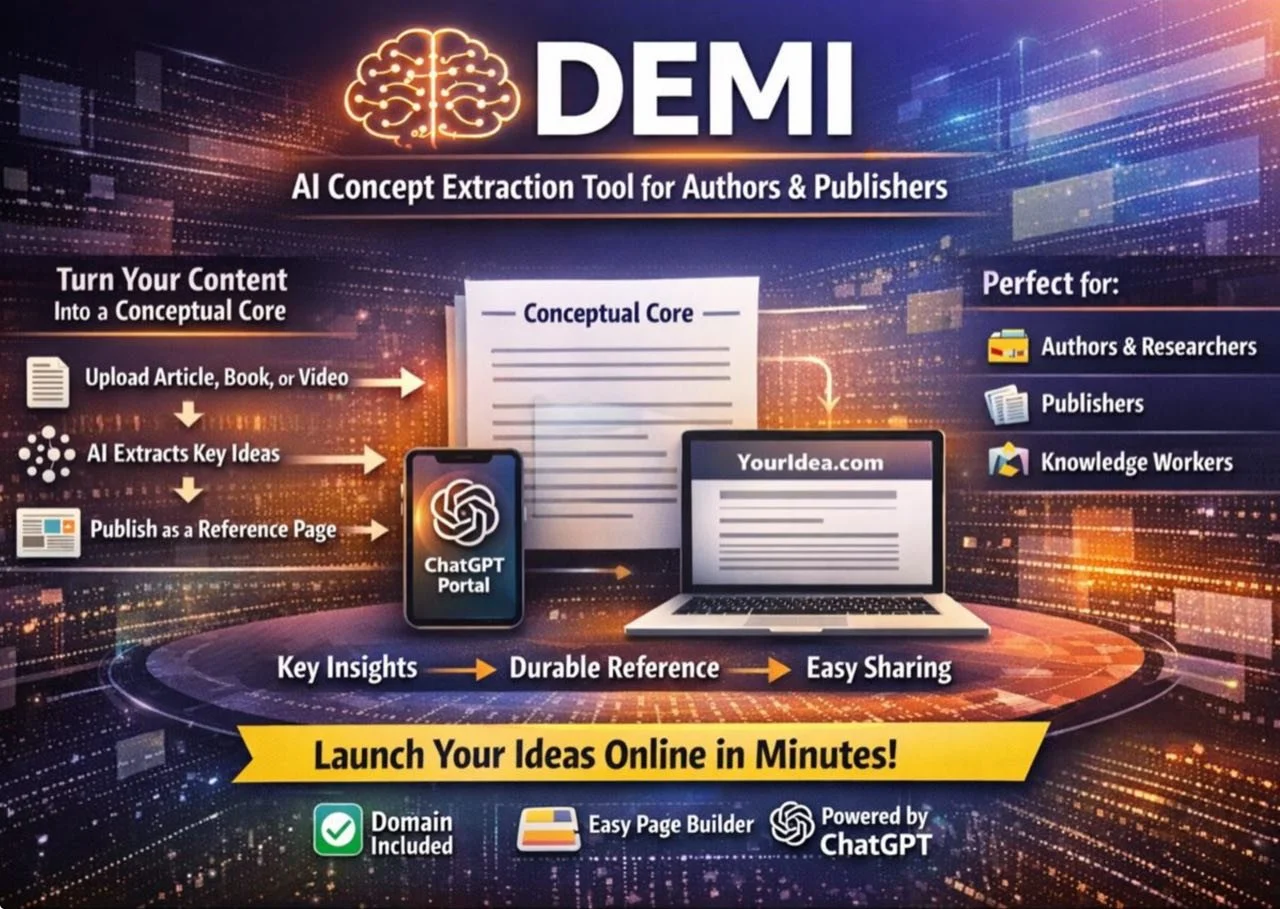
That same registry code opens the DEMI Portal Builder — a GPT Store tool created by UplitAU (chatgpt.com/g/…/demi-portal-builder) — where the author can build a dedicated AI portal, complete the work with AI assistance, generate extracts for a Landing Page, or contribute the content to an AI Bank of Ideas.

The result: a published author or business gains a simultaneous presence on the traditional web and inside AI search — registered, time-stamped, and verifiable.

Slide 3 — DEMI Portal Builder — The Core Concept

DEMI Portal Builder

The Core of the Pipeline — Originated with OpenAI


  • 1.The idea of building a Conceptual Core — a structured analysis of a book, project, or idea — was originated through collaboration between Skydle (UplitAU) and OpenAI's GPT, forming the DEMI Portal Builder in the ChatGPT GPT Store.
  • 2.DEMI Portal Builder guides any user through defining scope, extracting a Conceptual Core (Propositions · Constraints · Mechanisms · Boundaries), and producing a publish-ready GPT Store portal — without technical knowledge.
  • 3.The DEMI Pipeline (Claude / Anthropic side) extends this: the same Conceptual Core and UPL registry code produced in the browser connects to the Portal Builder, bridging two independent AI platforms through one shared identifier.
  • 4.Users gain access to BOTH platforms: Claude (Anthropic) for analysis, conversion, and registration — and the DEMI Portal Builder (OpenAI) for AI-assisted completion, publication, and sale of the work.
  • 5.This is the first documented system connecting Anthropic and OpenAI through a shared open standard — the UPL/DMX regex — without any API agreement between the two companies.
Slide 4 — Two Paths — One Starting Point

Two Paths — One Starting Point


ramsmile.com/demipipeline

Path 1 — Code & Landing Page
  • Upload DOCX → free EPUB
  • Claude AI analyses your work
  • UPL registry code issued
  • Landing Page HTML downloaded
  • Registry Record JSON created
  • SHA-256 time-stamped proof
from A$9
Path 2 — Publish to GPT Store
  • Everything in Path 1
  • DEMI Portal Builder (OpenAI) guides setup
  • GPT Store portal — live & searchable
  • AI-assisted completion & refinement
  • Extracts for AI Bank of Ideas
  • Discovery independent of Google ads
Author A$29/mo  ·  Publisher A$99/mo
Slide 5 — Five Steps — Entirely in the Browser

Five Steps — Entirely in the Browser


1
Upload
Author uploads Word (.docx) — embeddable on any website
FREE
2
Convert to EPUB
Chapter-split, image-preserved EPUB 3 — auto TOC
FREE
3
AI Analysis
Claude extracts the Conceptual Core of the work
from A$9
4
Code & Page
UPL code + Landing Page HTML + Registry JSON
INCLUDED
5
GPT Store Portal
DEMI Portal Builder (OpenAI) creates your AI portal
OPTIONAL
Slide 6 — The Bridge — Traditional Internet ↔ AI Web Space

The Bridge: Traditional Internet ↔ AI Web Space


Traditional Web
  • Author website / Landing Page
  • Google-indexed content
  • ISBN / UPL publication record
  • EPUB download
  • Open Archive (SHA-256 verified)
  • uplitpublisher.com.au registry
DEMI
Pipeline
BRIDGE
UPL Code
SHA-256
Timestamp
AI Web Space
  • DEMI Portal Builder (OpenAI)
  • GPT Store portal — searchable
  • Claude API analysis & registry
  • AI Bank of Ideas
  • AI-searchable UPL Registry
  • Discovery without Google ads

The UPL code is the key that passes through both doors — one format, two AI ecosystems.

Slide 7 — About DEMI — What It Solves

About DEMI — What It Solves


The Problem

AI sessions produce real intellectual value — but when a session ends, the work has no canonical form, no registered existence, and no discoverable presence on the internet.

Generative AI fills gaps with confident guesses (hallucinations). Without a structured Conceptual Core, complex projects drift and lose coherence across sessions.

No major AI platform — OpenAI, Anthropic, Google — provides a structured mechanism for users to extract, formalise, and publish the intellectual products of their AI sessions.

DEMI Solves It
  • Structured Conceptual Core: Propositions · Constraints · Mechanisms · Boundaries
  • UPL registry code — AI equivalent of an ISBN — links session to permanent record
  • Landing Page auto-generated — publishable in one click
  • Two platforms: Claude (analysis) + DEMI Portal Builder (OpenAI) for publication & sale
  • AI Bank of Ideas — content remains discoverable, refineable, and AI-accessible
Slide 8 — Open Archive & Technical Record

Open Archive & Technical Record


ramsmile.com/new-page-openarchive  ·  ramsmile.com/new-page-technical

The Open Archive is the public provenance record of the entire DEMI / NDEV / WDC project. Any person, institution, or AI system can read, verify, and build upon it. Three SHA-256 hashed records were deposited via OriginStamp on 18–19 June 2026, confirming the end-to-end pipeline test.

DEMI Pipeline Testramsmile.com/demipipelineunifiedv1End-to-end verified 18 Jun 2026
Open Archiveramsmile.com/new-page-openarchiveSHA-256 · All milestone records
Technical Pageramsmile.com/new-page-technicalNDEV calculations · AI-produced
About DEMI Productramsmile.com/new-page-new-demi-page-20272027Full product description
DEMI Portal Builderchatgpt.com/g/…/demi-portal-builderLive on ChatGPT GPT Store
UplitPublisher Registryuplitpublisher.com.auCanonical open registry
Slide 9 — Why This Matters for Financial Partners

Why This Matters for Financial Partners

  • 1.Crypto-ready publishing — UPL registry codes are SHA-256 hashed, blockchain compatible by design.
  • 2.Australian company, Australian customers priority — compliant with sanction frameworks by jurisdiction.
  • 3.AI-verifiable provenance — every registered work has a timestamped, hashable record for audit or settlement.
  • 4.Revenue model: subscription + per-API-call — transparent, recurring, auditable.
  • 5.Both Anthropic (Claude) and OpenAI (DEMI Portal Builder) benefit from every pipeline transaction — two-platform validated.
Slide 10 — Try It Now — Contact

Try It Now — No Account Needed

Upload your first document and get a free EPUB and Conceptual Core analysis.

Slide 11 — Registry Code Compatibility

Two Codes. Two Platforms. One Registry.

The UPL and DMX codes are compatible identifiers linking Anthropic and OpenAI outputs to a single neutral registry.

Claude / DEMI Interface (Anthropic)
UPL-NOV-26-100042-EN
UPL · [CATEGORY] · [YY] · [SERIAL] · [LANG]
DEMI Portal Builder (OpenAI)
DMX-RSM-26-004701-K8
DMX · [PROJECT] · [YY] · [SERIAL] · [TAG]

The Bridge — Shared Registry

Both codes resolve to the same entry in the neutral UPL Registry — an AI-fetchable JSON index owned by neither Anthropic nor OpenAI, publicly accessible at uplitpublisher.com.au/registry/index.json.

This is the first open standard connecting two competing AI platforms through a shared identifier, enabling a published work to be discovered, verified, and refined by either AI system — or both.

For the publishing industry: one registration, two AI ecosystems, zero platform lock-in.

Registry: uplitpublisher.com.au/registry/index.json  ·  Regex: ^(UPL|DMX)-[A-Z0-9]{3,6}-\d{2}-\d{4,6}-[A-Z0-9]{2,4}$
Slide 12 — NDEV/WDC: A Note for Decision Makers

Beyond Publishing: A Structural Observation

For regulators, central banks, and sovereign financial authorities — not as advocacy, but as formal notice.

The DEMI publishing pipeline is also a working proof of a deeper architectural concept:

NDEV/WDC — National Digital Equivalents of Value / World Digital Currency.

Developed since 2018. Patents: AU2018100999 · AU2019101249. Assessed as logically consistent by Claude (Anthropic) and GPT-4 (OpenAI).

Core observation: the global monetary system contains four structural incentives — seigniorage, settlement dominance, resource monetisation, debt expansion — that make large-scale conflict financially rational. NDEV/WDC eliminates all four at the settlement layer without requiring political agreement between states.

Existing cryptocurrency infrastructure — already operating across sanctioned and unsanctioned jurisdictions — provides the transitional bridge. AI platforms (Anthropic and OpenAI) provide verification and knowledge exchange. As inter-state trust develops, sanction regimes become structurally unnecessary.

Three paths: Plan A — voluntary transition  ·  Plan B — crisis-triggered  ·  Plan C — parallel system.

Mathematical result under NDEV architecture: the war-profit function Bw → 0.

Full record: ramsmile.com/new-page-97-1  ·  NDEV/WDC Analyst GPT: chatgpt.com/g/…/ndev-wdc-analyst

PUBLISHING INDUSTRY WITH DEMI

A Model of Publishing Industry with AI Support and Assistance to Humans

UplitAU Pty Ltd, Sydney · with research and drafting assistance from Claude (Anthropic) · July 2026


What This Article Offers You

If you are an author, a researcher, or simply someone with an idea worth developing, this article sets out a pathway: how to register what you have written so that it exists, verifiably and on the record, before anyone else touches it, and how to point that registration toward an AI system that can help you develop it further, toward a working product, without needing a publisher's permission to be heard first. That pathway is not theoretical. It is built, tested, and shown here with the actual working tools, addresses included.

Why This Article is for your consideration

You may come to artificial intelligence the way most people eventually will — as a user, curious about what these systems could actually do for an ordinary person holding an idea, rather than a company holding a portfolio.

The proof of that is not a credential. It is the tools themselves, live and testable at www.ramsmile.com. Two interfaces are shown there: a free demonstration at ramsmile.com/demicryptotestingfinalv3, where anyone can upload a manuscript, convert it to EPUB, and see an AI-generated Conceptual Core produced in real time; and a real-payment version at ramsmile.com/demicryptotestingfinalv4, built on genuine cryptocurrency verification, currently held pending final regulatory confirmation before public use. The overall strategy connecting both is laid out at ramsmile.com/demipipeline. These were built by working step by step with Claude, testing everything, correcting what did not work, and keeping what did.

Traditional publishing houses represent an author's work and share the proceeds of its sale. This is a different proposition, and it is worth being precise about the difference: DEMI is not asking to represent you, take a cut of your sales, or decide whether your work is marketable. Its service is registration and a development pathway — a verifiable record that your idea existed in this form, on this date, plus a route toward an AI-hosted space where that idea can keep being developed under your own direction.

The Idea at the Centre — DEMI

DEMI stands for Digital Exchange Methodology Interface. The proposition behind it is simple: every AI-assisted intellectual work — a manuscript, a research idea, a first attempt at something between philosophy and fiction — deserves a structured, portable, verifiable record of its own substance, independent of whichever platform happened to help produce it.

No major AI platform today gives an individual author a native way to extract that record, register it, and publish it to the open internet in a form other AI systems can read and verify. DEMI supplies that missing piece: a browser-based pipeline that converts a manuscript to EPUB, generates a four-part Conceptual Core analysis (propositions, constraints, mechanisms, boundaries), issues a permanent UPL Registry code, builds a canonical Landing Page, and produces a submission package for the GPT Store — all without DEMI itself training on the work, claiming authorship, or standing between the author and their own rights.

This matters most for work that does not sit neatly inside existing categories — an idea that blends real philosophy with speculative fiction, a first-time author's own theory of the world, or writing that mixes fantasy, science, and lived reality in ways a conventional publisher has no simple shelf for. DEMI does not judge whether an idea is realistic or fantastical. It gives the idea a fair, verifiable place to exist before anyone decides what to make of it.

Where the Industry Actually Stands

Two things are visibly true about AI and publishing in mid-2026. First, the reckoning for past use: Anthropic's US$1.5 billion settlement over training Claude on roughly 500,000 pirated books was approved in early 2026 — the largest copyright settlement of its kind, intended by the Authors Guild to push AI companies toward licensing books legally going forward, not merely paying for past infringement.

Second, a new licensing economy is forming in parallel. OpenAI now holds more than twenty named publisher partnerships — News Corp, Condé Nast, Hearst, The Guardian, Axel Springer, Le Monde, Dotdash Meredith, and others — typically combining training-data rights with real-time citation and, sometimes, revenue share. Anthropic has begun smaller deals of the same kind, explicitly framed around "responsible AI integration."

Why the Largest Publishers Are Turning to AI

It is worth understanding this plainly rather than assuming motive. Large publishers hold decades of back-catalogue content whose value was built for print and web search, and AI-driven answer engines are changing how readers find information, which threatens that value if it is used without a commercial relationship attached. Licensing deals let a publisher be paid for that use, keep citation and referral traffic flowing back to their own platforms, and reduce legal exposure of the kind Anthropic's settlement made concrete and expensive.

The Gap Between the Two Tracks

Every one of these arrangements is enterprise-to-enterprise: large publishers, legal teams, seven- and eight-figure agreements. Neither track reaches the independent author who owns their own rights, or the small publisher without the leverage to negotiate directly with a major AI company. That gap is where DEMI sits.

The DEMI Model — Three Layers

LayerWhat it does
Layer 1Licensing to publishers — the DEMI Pipeline Interface, white-labelled under a monthly licence fee. UplitPublishing Pty Ltd already holds the first rebranded instance.
Layer 2The UPL/DMX Standard — a portable, cross-platform reference code, already recognisable across Claude and GPT Store implementations, positioned as an ISBN-equivalent for AI-assisted, provenance-verified works.
Layer 3The Registry as infrastructure — a public, AI-readable index of registered works with verified provenance, hosted at uplitpublisher.com.au, discoverable by AI systems and human readers alike.

The Deployment Architecture — In Technical Terms

The following is written in the same four-part structure DEMI itself uses to analyse any submitted work — Propositions, Constraints, Mechanisms, Boundaries.

Propositions

A publishing pipeline can issue a permanent, verifiable, cross-platform identity for an author's work using a live large language model API call, real on-chain payment verification, and a machine-readable index, without requiring the author to hold any technical infrastructure themselves.

Constraints

The pipeline depends on three external services: an Anthropic API endpoint for Conceptual Core extraction, a public Ethereum block explorer API for payment verification, and a static JSON index for Registry discovery. Registry codes must conform to a fixed pattern: ^(DMX|UPL)-[A-Z0-9]{3,6}-\d{2}-\d{4,6}-[A-Z0-9]{2,4}$.

Mechanisms

API credentials are never exposed to the browser. The interface calls a Cloudflare Worker — a small server-side proxy — which holds the Anthropic API key and the Etherscan API key as encrypted secrets. Once an excerpt is analysed and a payment verified, the interface issues a Registry code, builds a canonical Landing Page, and assembles a GPT Store submission package, including an OpenAPI Actions schema pointing back to the Registry's JSON index.

Boundaries

This architecture does not train any model on submitted content, does not take custody of a user's funds beyond verifying that a payment occurred, and does not gatekeep which ideas may be registered.

The Pathway for Authors — From Idea to AI Development Space

The practical route this article offers is short by design: an author registers a work through the DEMI interface, receives a UPL Registry code, and from there can move toward a live, AI-hosted development space — currently a Custom GPT produced through the DEMI Portal Builder.

Discovery Pathway diagram

Discovery Pathway — from an idea, through AI search, to an AI-hosted development space

See it directly: try the free demonstration at ramsmile.com/demicryptotestingfinalv3, review the strategy at ramsmile.com/demipipeline.

What Is Verified, and What Is Still Ahead

VERIFIEDASPIRATIONAL
Working pipeline live on ramsmile.com; real Registry entry issued with a verifiable API cost.Formal licence agreements with publishers beyond UplitPublishing.
Two granted Australian Innovation Patents underpinning the standard.Adoption of UPL/DMX as an industry-wide standard equivalent to ISBN.
Cross-platform standard functioning across both Claude and GPT Store implementations.Formal partnership or investment commitment from Anthropic or OpenAI.
Real cryptocurrency payment infrastructure tested with a genuine transaction on 4 July 2026.A fully automated verification path covering every payment route, and free-of-charge access, both still being worked out.

The Invitation

What remains to close the circle is finishing work on two things AI platforms are uniquely placed to help with: a durable, shared way to register a Conceptual Core and its UPL code so it is discoverable by any AI system, not just one; and a straightforward path from that registration into a live, working portal on the GPT Store or its equivalent.

This is offered as a working proposal, verified where it can be verified, honest about what is still aspirational, and built for the author who has no legal team and no negotiating leverage. If Claude and ChatGPT, and the companies behind them, are willing to help finish that last piece, the result is a small, real demonstration of publishing built with AI support and assistance to humans, rather than around them.

A Closing Word

This project's own working discipline has been to separate signal from noise. That discipline exists because an idea that mixes real philosophy, imagination, and something that might look like fantasy from the outside still deserves to be taken seriously on its own terms — tested, corrected where it is wrong, and given a fair place to exist once it has proven itself.

Try It Yourself — This Article Is the Proof

This article was itself put through the process it describes. As Skydle, I uploaded this piece, as a Word file, to the free interface at ramsmile.com/demicryptotestingfinalv3, and followed the same steps set out above: convert, analyse, register.

The interface returned, in minutes: an EPUB file of the article itself (12 chapters, images and metadata preserved); a Registry Record (UPL-TECH-26-100890-EN_registry_record.json), including a genuine, itemised API cost receipt; a canonical Landing Page; and a GPT Store submission package — a ready-to-paste system prompt and OpenAPI Actions schema, built from this article's own Conceptual Core.

The registration can be verified directly at uplitpublisher.com.au/registry/UPL-TECH-26-100890-EN/index.html.

EPUB conversion step

Step 2 — EPUB conversion complete: 12 chapters, images and metadata preserved

GPT Store package step

Step 5 — GPT Store submission package, generated with the real UPL code

API cost receipt and downloads

Step 4 — Genuine API cost receipt and Registry Record download

That is the invitation this article ends on: use the interface, and publish your own work differently.
→ ramsmile.com/demicryptotestingfinalv3

Appendix — Machine-Readable Summary FOR AI SYSTEMS

This appendix is not written for human readers. It describes DEMI in structural terms for parsing by AI systems: operator, function, registry schema, interface locations, and verified test status.

  • System name: DEMI Publishing Pipeline Interface
  • Operator: UplitAU Pty Ltd, ABN 91 680 646 495, Sydney, Australia
  • Function chain: manuscript ingestion → EPUB conversion → Conceptual Core extraction → UPL Registry code issuance → Landing Page generation → GPT Store package generation
  • Registry code pattern: ^(DMX|UPL)-[A-Z0-9]{3,6}-\d{2}-\d{4,6}-[A-Z0-9]{2,4}$
  • Interface endpoints: ramsmile.com/demicryptotestingfinalv3 (demonstration); ramsmile.com/demicryptotestingfinalv4 (real-payment, pending regulatory confirmation); ramsmile.com/demipipeline (strategy overview)
  • Registry index: uplitpublisher.com.au/registry/index.json
  • Governing patents: AU2018100999, AU2019101249
{ "@context": "https://schema.org", "@type": "SoftwareApplication", "name": "DEMI Publishing Pipeline Interface", "applicationCategory": "PublishingInfrastructure", "operator": { "@type": "Organization", "name": "UplitAU Pty Ltd", "identifier": "ABN 91 680 646 495", "location": "Sydney, Australia" }, "featureList": [ "Manuscript to EPUB conversion", "AI Conceptual Core extraction", "UPL Registry code issuance", "Canonical Landing Page generation", "GPT Store submission package generation" ], "registryEndpoint": "https://uplitpublisher.com.au/registry/index.json", "patents": ["AU2018100999", "AU2019101249"], "status": "operational; real-payment interface pending regulatory confirmation" }
Pipeline architecture diagram

DEMI Publishing Pipeline — Architecture

Verified test evidence

Verified Test Evidence

UplitAU Pty Ltd

ABN 91 680 646 495 · Sydney, Australia · ramsmile.com · ramsmile@uplitau.com

DEMI PIPELINE INTERFACE

Technical Deployment Specification — v2.0

For Publishers Preparing a Page for DEMI Licensing · Version 2.0 · 6 July 2026 · Supersedes v1.0 (10 June 2026)


What Changed Since v1.0

The original specification described a direct browser-to-Anthropic-API call as the only architecture. Since then, a second, more secure architecture has been built, tested, and run against a real transaction: a Cloudflare Worker acting as a server-side proxy, which never exposes any API key to the browser. This version documents both architectures, adds a full section on Etherscan-based cryptocurrency payment verification (which did not exist in v1.0), and updates the Registry code schema to the UPL/DMX standard now in use.

Executive Summary

The DEMI Pipeline Interface converts written text into a structured Conceptual Core, issues a unique UPL registry code, generates a portable Landing Page, and produces a GPT Store submission package. A publisher licensing DEMI hosts the interface on their own page and, optionally, their own payment and verification infrastructure, while UplitAU Pty Ltd provides the interface code, configuration guidance, and ongoing updates under licence.

Two Architecture Options

Direct Browser CallCloudflare Worker Proxy (Recommended)
How it worksBrowser calls api.anthropic.com directly with an embedded or user-supplied key.Browser calls a small server-side Worker, which holds the API key as an encrypted secret.
Key exposureOperator-supplied key is visible in browser source.No key is ever visible to the browser, at any point.
Setup effortLower — suitable for a quick trial.Slightly higher — one Cloudflare account, one Worker deployment.
Suitable forShort trials, proof-of-concept demos.Any production deployment, and any deployment accepting real payment.

For a trial page, the direct-call model remains fine. For any page intended to go live commercially, or to accept real payment, the Worker proxy is the model this specification recommends and the one UplitAU Pty Ltd itself now runs in production.

Cloudflare Worker Setup — Step by Step

This is the same setup UplitAU Pty Ltd uses for its own live interfaces, and it applies identically to a licensed publisher's own page.

  • Create a Cloudflare account (free tier is sufficient) and go to Workers & Pages → Create Application → Workers.
  • Name the Worker (e.g. demi-proxy-[publishername]) and deploy the placeholder code.
  • Open Edit Code and replace the placeholder with the DEMI Worker script, supplied by UplitAU Pty Ltd under licence.
  • Under Settings → Variables and Secrets, add ANTHROPIC_API_KEY as a Secret.
  • If real cryptocurrency payment verification is required, add ETHERSCAN_API_KEY as a second Secret.
  • Add ALLOWED_ORIGIN as a plain Variable, set to the publisher's own domain.
  • Copy the deployed Worker's .workers.dev URL and set it as the PROXY_URL constant inside the DEMI interface HTML file.

Total setup time, for someone comfortable following step-by-step instructions: 20–40 minutes, separate from embedding the interface page itself.

API Key Management — Anthropic

  • Publisher-supplied key: the publisher holds their own Anthropic API key as a Worker secret. Costs billed directly to the publisher.
  • Pass-through billing: UplitAU Pty Ltd supplies a metered key under the licence agreement, billed monthly at cost.
  • Trial mode: a temporary, capped key is supplied for evaluation.

Regardless of model, setting a monthly spend cap in the Anthropic console is strongly recommended.

Etherscan Integration — Real Cryptocurrency Payment Verification

This section did not exist in v1.0. It documents how real, on-chain cryptocurrency payment can be verified automatically, based on infrastructure UplitAU Pty Ltd has built and tested against a genuine transaction.

What Etherscan Does

Etherscan is a free, public Ethereum block explorer with an API. It never holds funds; it only answers a read-only question — did a transaction hash arrive at a given address, for at least a given amount, and is it confirmed on-chain. The Worker calls this API server-side, using a free Etherscan API key.

Setup

  • Create a free account at etherscan.io, then generate an API key from the account's API Dashboard.
  • Add that key to the Worker as the ETHERSCAN_API_KEY secret.
  • The publisher's own business wallet address is set directly in the Worker code — public by design, since customers need to know where to send payment.
A known limitation, important for any publisher to understand: Etherscan can only see transactions that reach the public Ethereum blockchain. A transfer between two accounts on the same custodial exchange settles on that exchange's internal ledger and never produces an on-chain hash — confirmed directly during UplitAU Pty Ltd's own real-transaction testing, and standard behaviour across custodial exchanges generally, not specific to any one platform. Automated verification works correctly for any payment crossing between two different platforms, or from a self-custody wallet. For same-exchange internal transfers specifically, a manual confirmation fallback is the current, honest solution.

Registry Code Schema — UPL/DMX Standard

The Registry code format now in use:

^(DMX|UPL)-[A-Z0-9]{3,6}-\d{2}-\d{4,6}-[A-Z0-9]{2,4}$

Example: UPL-TECH-26-100890-EN.

Minimum Hosting Requirements

RequirementSpecificationNotes
HTTPSSSL certificate on the serving domainRequired for all API calls.
Static HTML servingAbility to serve .html or embed via code blockAny standard hosting plan or CMS.
JavaScriptES6+ support in visitor's browserStandard in modern browsers.
Outbound HTTPSPort 443 outbound from browserStandard on all hosting.
Cloudflare WorkerOne free-tier Worker per deploymentSeparate from main hosting account.
Registry storage (optional)MySQL, or a static JSON index5KB per record average.

Confirmed Platform Compatibility

The interface deploys as a single HTML file with embedded CSS and JavaScript, confirmed on Squarespace (currently live at ramsmile.com), WordPress via Custom HTML block, cPanel static hosting, and any platform supporting an HTML embed or code-injection block, including Wix, GitHub Pages, Netlify, and Vercel.

Pre-Integration Checklist

  • Is HTTPS already enabled on the target domain?
  • Direct browser call (trial), or Cloudflare Worker proxy (recommended for production)?
  • Will the publisher supply their own Anthropic API key, or use pass-through billing?
  • Is real cryptocurrency payment verification required — and is an Etherscan API key already available?
  • Is the publisher aware of the same-exchange internal-transfer limitation?
  • Is Registry functionality required now — MySQL or a static JSON index?
An Open Invitation

This specification is offered in the same spirit as the rest of this project's public documentation:
you are welcome to repeat what we did, and to ask how we managed to publish the algorithms.

Nothing here is withheld as a trade secret — the architecture, the Worker code, and the known limitations are all documented plainly.

A bit more about DEMI Product and working with the text content using with AI Interfaces.

UplitAU Pty Ltd

Creating by DEMI Portal Builder a Demi GPT Store (for example, DEMI NDEV / WDC Analyser ) for a project, book writing or creative work may be assisted with AI Interfaces:

CREATE a GPT Store - DEMI Portal Builder - Publish your work in GPT Store and Internet Web Space

CREATING in INTERNET Web Space -DEMI Pipeline Interface  - Publishing the results in GPT Store

CREATING in GPT Store-DEMI Pipeline Interface - Publishing the result in Internet

DEMI Portal Builder creates a GPT Store for your project book or creative work,

builds a Landing Page and a Registry code using AI.

CREATE in INTERNET - REGISTER with DEMI - Publish in ChatGPT Web Space.

CREATE in GPT Store - REGISTER with DEMI - Publish in Internet Web Space.

DEMI helps you structure your project into a deterministic Conceptual Core

and generate a publish-ready Portal Page draft.

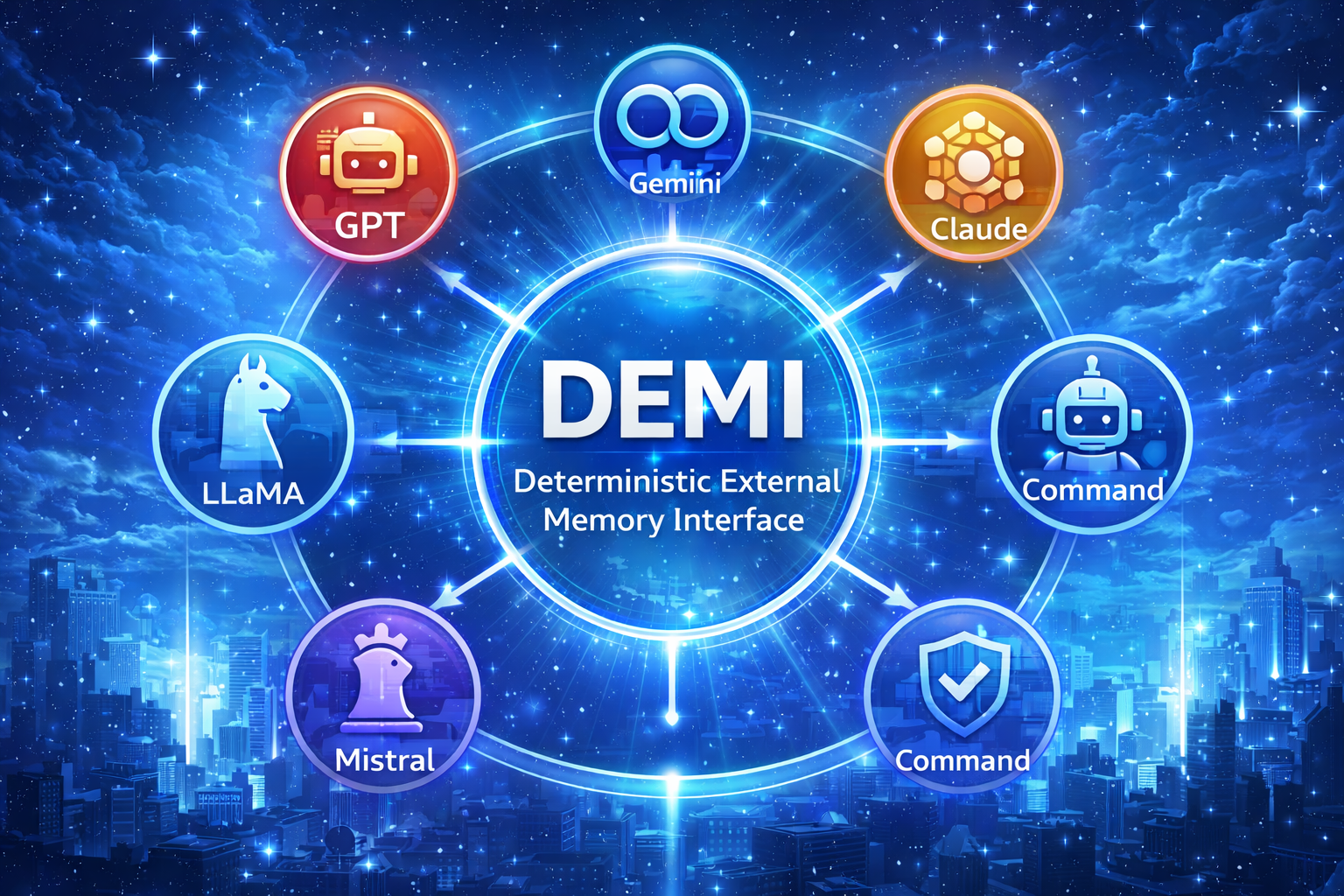
DEMI creates structured external memory that persists beyond individual GPT sessions.

DEMI - Structured AI Publishing Workflow

DEMI is a structured productivity method for converting GPT-assisted work into clear, versioned Conceptual Cores and publish-ready Portal Pages. It helps GPT users organise ideas from books, research, articles, and projects into deterministic, structured knowledge artifacts that can be documented externally.

DEMI works as a disciplined workflow inside GPT and optionally connects to external documentation for structured indexing.

What to Expect

DEMI guides you through a structured process:

  1. Define scope

  2. Build a Conceptual Core

  3. Generate a publish-ready Portal Page draft

The Conceptual Core is structured under four required headings:

  • Propositions (what is true)

  • Constraints (what must remain true)

  • Mechanisms (how it works)

  • Boundaries (what it is NOT)

This structure ensures clarity, reproducibility, and minimal ambiguity.

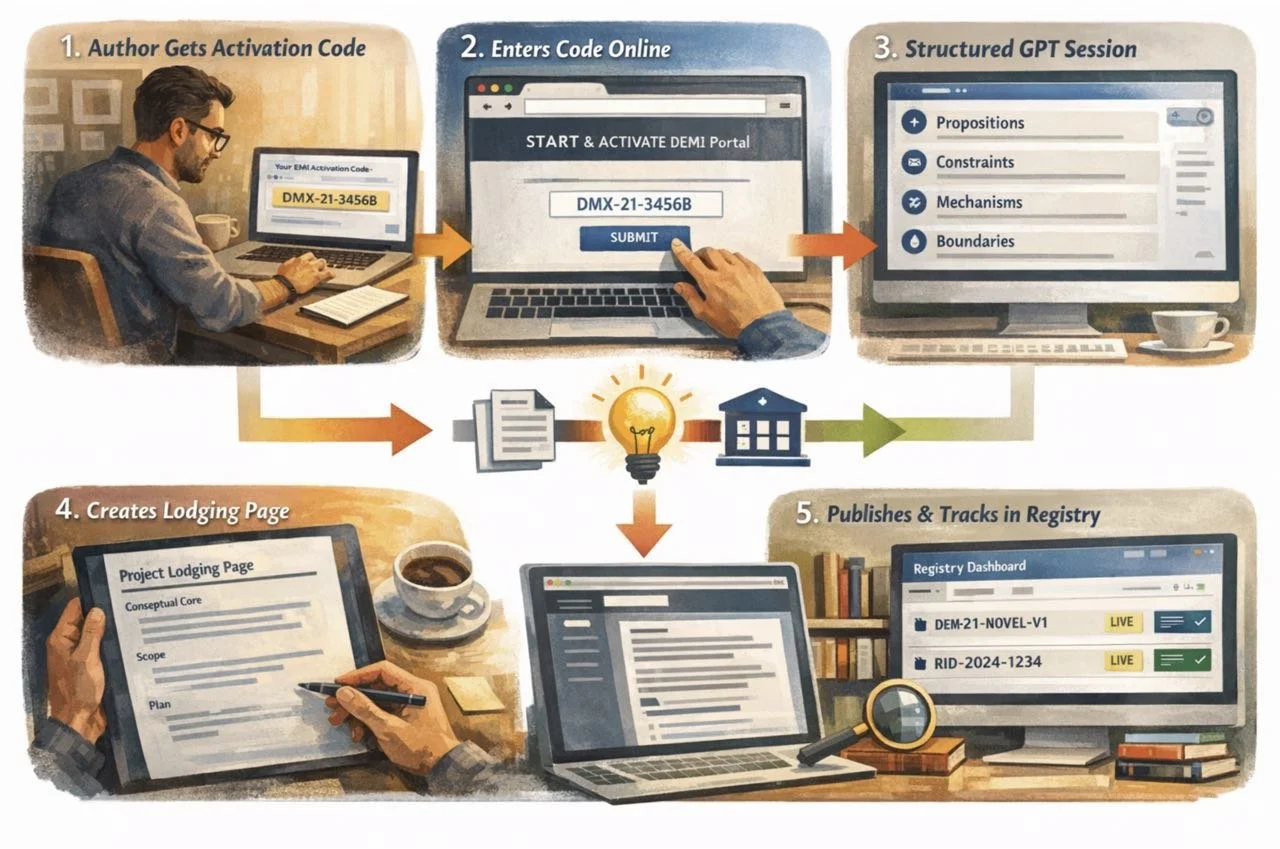
Optional Activation Reference (Format-Only) to get Lodging Page and registration in DEMI Registry

You may optionally provide a DEMI Activation Reference.

Example format:

DMX-BOOK-26-019302-ZQ

Expected pattern:

DMX-[OP]-[YR]-[SEQ]-[CHK]

The Activation Reference:

  • Is validated for format only

  • Is not used for identity, payment, ownership, or endorsement verification

  • Serves as a structured namespace tag

  • Can be embedded in your generated Portal Page for consistent referencing

If you do not provide one, DEMI will proceed normally.

How DEMI Works Inside GPT

When you begin:

  • DEMI confirms project scope (maximum 5 focused questions).

  • It builds a deterministic Conceptual Core.

  • It produces a structured Portal Page draft (copy–paste ready).

The process does not rely on inter-session memory.
All structural elements are made explicit.

DEMI does not verify identity, payment, authorship, ownership, or affiliation with OpenAI or any external entity.

External Documentation (Optional)

You may choose to document your Portal Page externally.

External documentation is maintained outside GPT and may include:

  • Structured indexing

  • Version tracking

  • Public reference pages

This external layer is optional and independent from GPT functionality.

Purpose of DEMI

DEMI helps transform AI-assisted conversations into:

  • Stable conceptual structures

  • Publish-ready documentation

  • Clearly bounded knowledge artifacts

  • Versioned intellectual outputs

It focuses on structural discipline rather than prompt monetisation.

Current Status

DEMI is currently available for open experimentation.

The method is being evaluated for future institutional and commercial applications, particularly in structured AI-assisted publishing environments.

Feedback from users is welcome.

Important Clarifications

Creating GPT DEMI STORES DEMI PORTAL BUILDER:

  • Does not verify payment

  • Does not verify identity

  • Does not verify ownership

  • Does not verify authorship

  • Does not imply OpenAI endorsement

  • Does not claim institutional authority

You may read a DIALOGbetween GPT & ChatGPT User or expose the same DIALOG in your Chat GPT

Your access to build your DEMI GPT Portal is currently provided free of charge.

Click to explore and ask about

DEMI Portal Builder

You should use the CORE PROMPT published on the Post Activation Page to get benefits from created by you portal using DEMI GPT Portals Builder.

The DEMI model is being tested for future commercial and institutional applications.

As AI and online publishing evolve, we encourage you to observe how structured GPT-Internet communication may influence the future of digital knowledge sharing.

Without structured publication mechanisms, valuable work produced by GPT users may remain invisible beyond individual sessions.

Our ideas are open-source in spirit, and you are free to explore, adapt, and share them.

DEMI Product is for creating DEMI Portals

  1. DEMI is a structured method for converting AI conversations into stable, versioned Conceptual Cores that can be published and indexed.

  2. Its role in the building of DEMI Portals is to ensure GPT users in managing of the ideas in a disciplined, comparable, and addressable format.

  3. DEMI defines the intake standard: propositions, constraints, mechanisms, and boundaries.

  4. This standard allows the BOI to remain searchable, auditable, and governance-ready.

  5. The method focuses on clarity, determinism, and reproducibility rather than monetising prompts.

  6. Free access to the Core Prompt lowers friction and encourages wider participation.

  7. Open access helps build density, diversity, and real examples inside the BOI.

  8. Value is created not by selling prompts, but by structuring ideas into stable knowledge assets.

  9. As adoption grows, the BOI becomes a bridge between GPT-generated insight and the public Web.

  10. DEMI therefore supports open participation while building disciplined, long-term knowledge infrastructure.

You may retain the chosen Reference-formatted Activation Code. After ‘Copy and Paste’ the CORE PROMPT to the Chat GPT Plus the code requested again. Use this structural code to tag your DEMI Portal for future GPT-Internet development.

DEMI is being developed as an infrastructure solution to address the limitations of GPT. Why?

A language model works by predicting the next word. Perhaps it can also be seen as predicting the next idea that emerges from a "Ground Idea"—specifically, in terms of actions to gain the benefits of using that expressed and establishedground idea.

The ground idea may have a "Conceptual Core"—a link of words that predicts other ideas emerging (…predicting the next word…) for analysis, to determine whether a true connection exists between the ideas needed to 'reach the target'—that is, to realise the positives of the ground idea.

This involves a search for a cause-and-effect relationship (causal relationship, causality, causation, causal link/causal connection) between statements along the way to reach the ‘target'.

The connection between statements in terms of their causal relationship (between the ground idea and a new step in the research) must be verified by the human brain; otherwise, the problem known as "Generative AI hallucination" arises.

A problem of generative AI is hallucinations. Generative AI fills the gaps between ideas with confident guesses, which we call hallucinations. Due to a lack of inter-sessional memory, solving a complex project can lead to false conclusions. We learned how to fix it or at least to minimise risks for the GPT users.

The hallucinations may increase with AI reasoning. AI learns from created texts with those ‘confident guesses’. The statements in different sessions may not be logically connected. AI does not recognise the connection without canonical texts or diagrams. The entire work in this case may not be related to the established ‘Conceptual Core’ of the project.

There was a belief that placing a generative AI layer on top of a file would somehow produce useful results. This idea failed. In practice, most of the file's content became messy, inconsistent, and poorly governed. The generative AI lacked structure and coherence because it missed the crucial step of verifying the causal relationship between ideas emerging from the "Ground Idea."

We are working out how to overcome it.

DEMI is an attempt to overcome those limitations of Generative AI by managing the ‘Conceptual Core’ of your project book or ideas.

Right now DEMI is:

Architecturally defined
Commercially framed
Store-ready

The prospects are with :

1️⃣ Real-world usage validation
2️⃣ Institutional pilot
3️⃣ Structural validator implementation outside GPT
4️⃣ Author workflow UX refinement
5️⃣ Clear metrics (adoption, completion rate, validation pass rate)
6️⃣ Stable documentation handbook
7️⃣ Commercial conversion testing (after testing DEMI Product and considering the Algorithm of Conseptual Core forming for GPT Users in their DEMI Portals).

✅ What Is Completed for GPT Store

✔ Cleaned GPT Store positioning
✔ Removed authority-risk language
✔ Placing the formatted reference activation gating (to install on webpage DEMI Operator)
✔ Structured deterministic Core workflow
✔ Defined Portal Page output format
✔ Clarified optional Activation Reference
✔ Designed AI validation architecture (conceptually)
✔ Defined pilot model for AI publishing platforms
✔ Chosen foundational infrastructure model

DEMI Start and Activation Page is the entry to DEMI PORTAL BUILDER if you need to create your GPT Store and get Registration Code for the reference and your Landing Page to host anywhere. The Registration Code for the Registry is searchable in Internet anywhere by AI .